Water supply interruptions on a private borehole put homeowners who rely entirely on groundwater under immediate pressure. Knowing the borehole pump repair cost in South Africa helps you tell a minor electrical fix from a major capital outlay before a technician arrives. Pricing for these specialist jobs differs sharply from standard residential plumbing, because the work involves high-voltage electrical diagnostics, heavy lifting equipment, and components rated for continuous submersion. This guide breaks down current 2026 market rates so you can evaluate quotes accurately and avoid paying emergency prices for what is really routine maintenance.
Average Borehole Pump Repair Costs in 2026
Budgeting for a borehole repair means separating the fixed cost of getting a specialist to your site from the variable costs of parts and labour. Expect the initial diagnostic visit to cost more than a standard domestic callout. Borehole technicians carry specialised testing equipment and often travel further to reach rural or semi-rural properties. A control box replacement is often a fraction of the cost of pulling and replacing a burnt-out submersible motor at depths over 60 meters, which is exactly why getting the diagnosis right the first time matters financially.
Call-Out Fees and Diagnostic Charges
The typical price for diagnosing a borehole pump fault in South Africa sits between R1,500 and R3,500 for a standard weekday visit. This fee covers the technician’s travel, the use of insulation resistance testers and clamp meters, and the first hour of assessment time to isolate the failure point. Deeper installations or sites with difficult access may carry a higher baseline diagnostic charge, since the technician has to deploy winching gear just to run preliminary tests. Our technicians carry common control box components to resolve surface-level faults during the initial callout where possible. That can turn a diagnostic fee into a completed repair without a second visit.
Labour Rates for Borehole Specialists
Borehole specialists charge hourly labour rates that reflect their dual competency in electrical systems and hydraulic mechanics, not general plumbing tariffs. Current 2026 rates for qualified borehole electricians and pump installers typically run from R850 to R1,400 per hour, depending on how complex the extraction is. These rates apply while the team is actively working the system: pulling the pump assembly, testing motors on the bench, reinstalling new cabling. If you’re comparing multiple estimates, understanding call-out fee structures specific to borehole work prevents confusion between diagnostic charges and actual repair labour.
Common Borehole Pump Faults and Repair Prices
Repair costs vary a lot depending on whether the failure sits above ground in the control electronics or below ground in the submersible motor assembly. Diagnosing it accurately means measuring running amps and insulation resistance to distinguish surface electrical faults from downhole motor failure. Misidentify the fault and you pay for work you didn’t need. Submersible pump motors typically last 8 to 12 years depending on water quality and usage cycles, so a pump’s age is already a strong clue to where the fault is likely sitting.
Control Box and Capacitor Failures
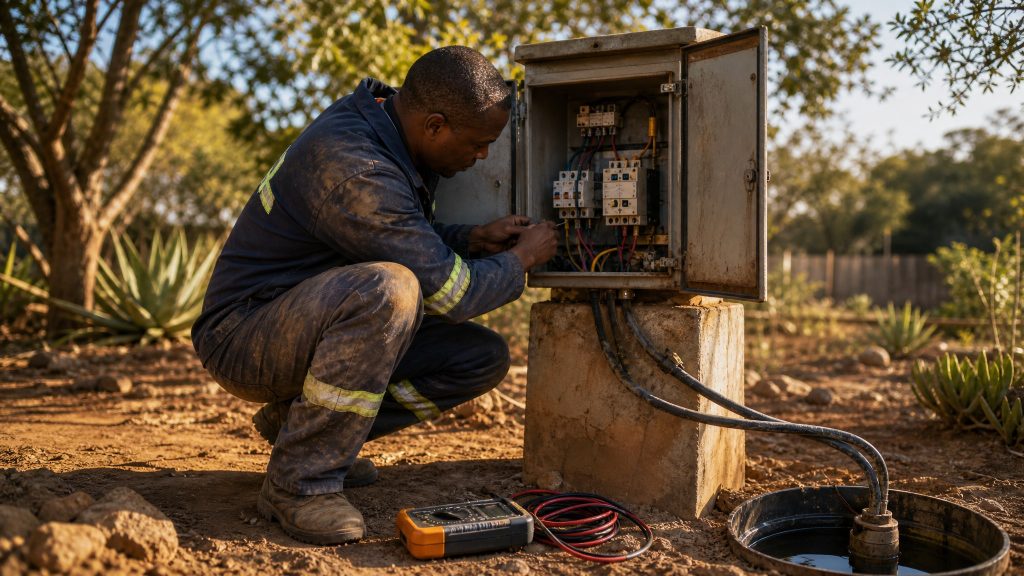
Control box failures are the most common and least expensive category of borehole repairs. A complete unit replacement, parts and labour included, typically costs between R2,500 and R5,500. Capacitors degrade over time from heat cycling and power surges, causing the motor to hum without starting or trip breakers intermittently. Replacing a capacitor alone costs significantly less than a full control box swap, but older units often warrant complete replacement anyway, since other internal relays are likely near end-of-life too. Surface-level electrical repairs like these can usually be finished within two hours of the diagnosis.
Impeller Blockages and Wear
Sand ingress and mineral buildup make impellers seize or wear unevenly. Flow rate drops, motor amperage climbs, and eventually the system fails outright. Repair pricing for impeller issues depends heavily on whether the pump can be serviced on-site or has to be pulled to a workshop for disassembly and reassembly. Minor blockages cleared during a routine pull might add only R1,500 to R2,500 in labour to an existing job. Severely worn impeller stacks need component replacement, which pushes costs toward R6,000 or more. Sandy boreholes accelerate this wear pattern, which is why sediment filtration upstream of the pump matters for long-term cost control.
Electrical Cable and Joint Repairs
Damaged submersible cable or failed waterproof joints cause many of the intermittent faults that are expensive to diagnose but fairly straightforward to fix once you’ve located them. Splicing new cable sections or replacing resin-filled joints typically costs between R3,000 and R7,000, depending on depth and how much cable needs replacing. The main cost driver here is the labour time needed to pull and lower the pump assembly safely; the materials themselves are a small part of the invoice. Poor original installation using inferior jointing compounds often causes premature failures that keep recurring unless the repair upgrades the joint to proper heat-shrink or resin-sealed connections.
Borehole Pump Replacement Cost vs Repair
Deciding between repairing an aging pump and installing a new unit means weighing the pump’s remaining service life against what you’ve already spent repairing it. There’s a tipping point where sinking more money into a failing motor stops making financial sense next to the warranty security of new equipment. That calculation shifts with borehole depth, since deeper installations make each intervention proportionally more expensive because of the extra labour and rigging involved.
When Repair Is No Longer Viable
Replacing a borehole pump becomes cheaper than repairing it once the estimated repair cost passes 60% of a new installation’s price, for units older than eight years. Motor burnouts in pumps approaching a decade of service rarely justify rewinding or component-level repair, because stator insulation degradation usually signals the whole unit is near end-of-life. Multiple failures within an eighteen-month period are another signal that piecemeal repairs aren’t worth it anymore, whatever the individual repair costs look like. Seeking specialist repair quotes for comparison helps establish whether your situation calls for repair or replacement, based on current local pricing.
New Submersible Pump Installation Pricing
Full submersible pump replacements in 2026 typically range from R18,000 to R45,000 installed, depending on depth, flow rate requirements, and brand. That price bracket includes the new pump motor, matched control box, the right length of submersible cable, safety rope, and all labour for removal and installation. Higher-capacity pumps for large households or irrigation systems sit toward the top of this range; basic residential units for shallow bores sit at the bottom. New installations carry manufacturer warranties on both parts and labour defects, financial protection a repaired unit can’t offer.
Signs Your Borehole Pump Needs Professional Attention
Ignoring early warning signs turns minor adjustments into catastrophic failures that cost multiples of a preventative call-out. Recognising these symptoms lets you ask for targeted help instead of paying for open-ended diagnostic time.
If your system shows any of these, delaying an assessment risks losing your water supply completely, usually at the worst possible moment.
Low water pressure or reduced flow often points to impeller wear, a partial blockage, or a dropping water table. Intermittent operation, where the pump cycles on and off without demand, suggests pressure switch failure, air leaks in the drop pipe, or a control box relay problem. Tripping circuit breakers or blown fuses point directly to electrical faults, anything from degraded cable insulation to seized motor bearings drawing too much current. Grinding, cavitation sounds, or electrical humming without rotation call for an immediate shutdown to prevent further damage. Discoloured water or sudden sediment signals casing deterioration or a pump intake positioning issue that needs a physical inspection. For situations where the water supply has already failed completely, emergency borehole assistance provides after-hours response to restore critical services.
This kind of triage doesn’t replace professional testing. Attempting electrical troubleshooting yourself risks a fatal shock from submersible system voltages.
Factors Influencing Borehole Repair Quotes
Two identical pump failures can generate invoices differing by thousands of rands, purely because of the site’s physical characteristics. Understanding these variables explains why quotes differ and helps you give accurate information upfront so you’re not hit with a revised estimate mid-job. Physical constraints dictate equipment and crew size, and that drives labour costs regardless of how complex the actual repair is.
Borehole Depth and Casing Diameter
Depth is the single largest cost multiplier in borehole repair, because every extra meter adds weight, friction, and risk to pulling the pump. Standard residential bores between 40 and 80 meters fall within normal service parameters, but installations past 100 meters need heavier winching equipment and extra crew for safe handling. Narrow casing diameters under 100mm limit which pumps can go in and complicate retrieval if the pump sticks on the way out. Cased versus uncased sections affect pricing too, since collapsed or damaged uncased boreholes may need rehabilitation before any pump work can start.
Remote Location and Access Challenges
Properties far from service centres pick up travel surcharges that reflect real fuel costs and technician transit time, not arbitrary markups. Difficult site access, where trucks can’t get close to the borehole head, adds manual labour time for carrying equipment across uneven terrain. Rural locations with poor roads increase vehicle wear and stretch journey times, and responsible operators build those factors into their fair plumbing pricing models transparently. Wet weather that makes access tracks impassable can also delay a response or force a different route, which adds to the quoted travel cost.
Getting an Accurate Borehole Repair Quote
Giving full site information before you ask for a quote cuts out the guesswork that inflates estimates with contingency buffers. Technicians need specific data points to source the right parts and bring the right equipment for your installation. Vague descriptions force contractors to quote for the worst case, just to protect their margin against the unknowns.
Information to Provide Before Callout
Accurate quoting needs your borehole depth, casing diameter, pump brand and model if you can see it, and the specific symptoms you’ve observed. Photos of the control box label, the wellhead configuration, and any visible damage help technicians pre-diagnose before they even arrive. Records of past repairs, the pump’s installation date, and water quality test results give context for recurring problems. Electrical supply specs, including voltage phase and breaker rating, determine which replacement components will actually fit. Sending this information through our contact form gets you a tailored estimate rather than a generic price range that may not match your situation.
Understanding Warranty on Parts and Labour
Warranty terms for submersible components differ from standard plumbing guarantees, because these systems operate in conditions the installer can’t control. Manufacturer warranties on new pumps typically cover defects for one to two years but exclude damage from dry running, sand abrasion, or lightning strikes. Labour warranties on repairs generally run three to six months and cover only the specific work done, not unrelated failures that come up later. Clarifying warranty scope before you authorise work prevents disputes when an excluded condition causes a repeat failure. Always ask for written warranty documentation spelling out what’s covered, what voids it, and how to claim.
Preventative Maintenance to Reduce Future Costs
Annual inspections catch degrading components before they fail outright, spreading maintenance costs across predictable intervals instead of emergency premiums. Installing dry-run protection prevents motor burnout during low-water periods, which is one of the most common causes of a pump dying early. Checking control box capacitors and electrical connections every year catches heat damage and corrosion before they cause a system failure. Testing water quality and sediment levels tells you whether a filtration upgrade would protect the pump’s internals from abrasive wear. Scheduling maintenance in the dry season, when water demand is lower, avoids peak-period pricing and means the technician has time for a thorough assessment rather than a rushed one.
A borehole maintenance plumber can set up a service schedule matched to your system’s age and usage, turning unpredictable repair bills into a manageable, planned cost.