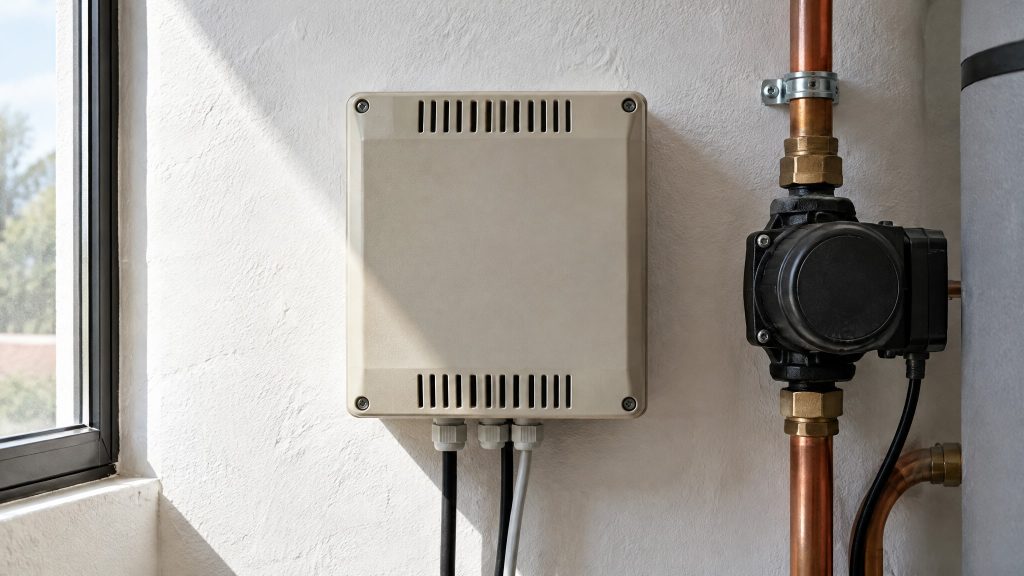
When the display on your solar geyser goes blank or starts flashing a code, the first question is usually what it will cost to fix. The honest answer starts with the controller, because that small box on the wall decides whether the rest of the system behaves.
This guide covers what the controller does, how fault codes group together, which checks are safe for you to make, and when a repair stops making sense. It also explains what moves a controller replacement quote up or down. It sits alongside our guides to thermostat and pump costs, so you can rule those parts in or out first.
What a Solar Geyser Controller Does
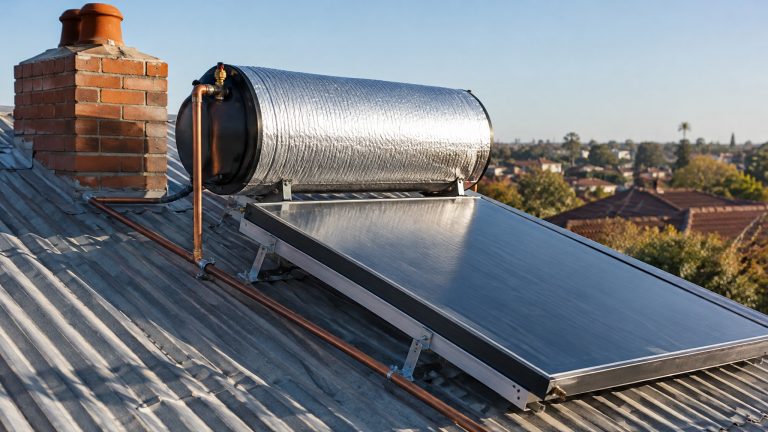
In South Africa, most solar geysers sit on a sunny roof and lean on an electric element for cloudy days and winter evenings. The controller is what lets the two heat sources work together without wasting power.
It reads the collector and tank sensors, compares the two temperatures, and decides when the backup element may switch on. In a pumped system it also switches the circulation pump, so water only moves through the collector when the panel is hotter than the tank.
Thermosyphon units have no pump, because hot water rises on its own. On those systems the controller mostly looks after the element and the display.
That is why a controller fault rarely announces itself as “controller fault”. You see it as a dead display, a pump that stays silent on a bright day, or an element that runs when it shouldn’t. Each of those can also come from a thermostat, a pump or a tank problem, which is why the diagnosis matters before anyone quotes.
Solar Geyser Controller Not Working: Fault Codes and Warning Signs
A controller that is not working can fail loudly, with a code, or quietly, with nothing on the screen at all. Both leave clues you can read before you pick up the phone.
Solar Geyser Error Codes in South Africa: What the Patterns Mean
Fault codes and LED blink patterns differ from brand to brand, so the manual or the label on the unit is the final reference. Even so, nearly all of them fall into four families:
- Sensor faults. The controller sees an open or shorted collector or tank sensor, often a damaged, loose or water-affected lead. Your unit may show this as a temperature reading that looks impossible.
- Over-temperature. The collector or tank has passed a safe limit, which can happen on a hot day with low hot-water use. Sometimes it points to a stuck sensor reading instead.
- Pump or relay faults. The controller is calling for the pump, or the relay that drives it, and not getting the expected result. This only applies to pumped systems.
- Power-supply faults. The unit has lost mains, blown a fuse or tripped on a surge, and the display may go dark.
Treat the family as a pointer, not a verdict. Sensor codes, for example, are the cheapest to fix when the lead is the culprit and the most misread when the controller board itself is failing.
A code that returns right after you clear it usually means a real fault, not a one-off glitch.
Symptoms That Point to the Controller, Not the Geyser
Three symptoms most often implicate the controller. The first is a blank display while the tank still delivers hot water. The second, in pumped systems, is a silent pump on a sunny afternoon. The third is the element switching on at the wrong times, such as at midday when the collector should be doing the work.
Take a typical case: the display goes dead after a storm, but the taps still run hot. That points first to the controller’s supply, fuse or board, not the tank, so test that before anyone prices a tank job.
Other faults mimic these signs. No hot water at all, or water that never gets hot, is more likely to be the thermostat or element, and our geyser thermostat replacement cost guide helps you judge that. If the pump is silent and the controller shows power, see solar geyser pump replacement cost before you blame the controller.
Self-Diagnosis Steps Before You Call a Technician
A few minutes of careful looking can save you a call-out fee, or at least give the technician a head start. It will not tell you whether the board has failed, and it is no substitute for electrical testing.
Safe Checks a Homeowner Can Make First
Work through these in order and stop the moment anything looks unsafe:
- The code. Write it down and photograph the display or the LED pattern before touching anything.
- The breaker. Check that the geyser’s breaker at the distribution board is on and has not tripped.
- The fuse. Only if the manual says the fuse is user-accessible, isolate the supply and then check it.
- The sensor leads. Look for leads that are loose, scorched or water-stained where they enter the controller or run across the roof.
- The pump. On a pumped system, listen for it on a sunny day when the collector is warm.
Stop at the first sign of water inside the controller housing, a burning smell or exposed live wiring. Switch off at the board and call a registered electrician or plumber.
Mains-side work on a controller counts as electrical installation work. The safe default is a registered electrician who issues a certificate of compliance for the job, so leave the covers on and the wiring alone.
Solar Water Heater Controller Repair or Replacement: Which Makes Sense
Before you choose between a repair and a new controller, look at the tank and collector. A fresh controller will not cure a leaking tank or a scaled-up collector, and it makes no sense to spend on one if the rest of the system is failing. Our geyser repair or replace decision guide walks through that judgement.
When a Controller Repair Is the Right Call
If the tank and collector are sound, repair is usually the cheaper route. That holds when the fault is something simple, such as a blown fuse, a loose terminal or a damaged sensor lead, and when the controller is still supported with available parts.
A like-for-like swap also belongs here. If the unit is the right model for your pump, sensors and element, and the fault is confined to the controller, a direct replacement keeps the rest of the system untouched.
When Replacing the Controller or the Whole System Beats Repair
Some controllers are not worth repairing. An unsupported model with no parts, a unit with water damage inside, or one that fails again and again after repairs will keep costing you call-outs. If the tank is also near the end of its life, you are paying to prop up one part of a system that is about to fail anyway.
In that case a complete system can be the better spend. The listed prices below are approximate and change, so use them as a whole-system reference point, not as a controller price. All three are complete Apollo high-pressure thermosyphon systems.
- The complete 150L high-pressure solar geyser suits smaller homes, townhouses, flats and family properties. It is listed at around ZAR 16,332.
- The 200L high-pressure solar geyser for larger family homes suits medium to larger households where several people use hot water daily. It is listed at around ZAR 19,325.
- The 300L high-pressure solar geyser for heavy hot-water use suits bigger households, guest houses, small lodges, shared accommodation and staff housing. It is listed at around ZAR 28,085.
If your controller fault sits on a tank you already doubt, asking for a whole-system quote alongside the controller quote costs you nothing and shows the real choice.
Solar Geyser Controller Replacement Cost: What Drives the Price
A controller replacement bill has two halves, the part and the labour. Neither is fixed, which is why two quotes for the same fault can look far apart. We explain the drivers here instead of quoting a single number, because the model and the site decide most of it.
Solar Geyser Control Panel Price by Brand and Model
The solar geyser control panel price depends first on the model. A basic unit that only manages the element costs less than a full controller that handles two sensors and a pump, and the price follows the features you actually need.
Fit matters just as much as features. The controller has to match your pump, your sensors and your backup element, so a cheaper unit that doesn’t match them can cost you more in the end.
Brand plays in as well. Established brands tend to have parts and technical support available for longer, while obscure or discontinued units can be cheap to buy but hard to service. Like-for-like replacement is the lowest-risk route, and an upgrade, say to a controller with more functions, raises the parts line.
A controller-only swap sits well below the price of a complete system. You will not get a trustworthy figure from a description alone, so ask a technician to confirm the exact model against your unit.
Labour, Call-Out and Extras That Change the Final Bill
Labour is where quotes diverge most. The same controller can cost very different amounts to fit, depending on these items:
- Call-out. Distance and the time of the visit set this charge.
- Roof access. If the fault involves collector sensors, someone has to get up there safely, which adds time.
- Sensor or cable replacement. A damaged lead or run of cable adds both parts and hours.
- Electrical testing. The technician has to confirm the supply and the circuit are sound before and after the swap.
- Certificate of compliance. Mains-side work needs one, and it forms part of a legitimate job.
A cheap quote that leaves out the certificate or the testing is not really cheaper. You will either pay for them later or end up with an installation that has no paperwork behind it.
Protecting Your Controller from Surges, Moisture and Lightning
Most controller failures trace back to the electrical supply or to water getting in. You can head off a lot of both with a few inexpensive measures.
Surge protection at the distribution board is the first. Lightning and grid surges can kill a controller outright, and repeated on-off cycling during load shedding stresses the board over time. A registered electrician can fit protection at the board and tell you what suits your installation.
Moisture is the second threat. Sensor leads should be secured to the roof and tank with their cable entries sealed against rain, because loose leads and open entries let water creep into the controller housing.
After a storm, take a quick look. If the display is blank or the code has changed, check the breaker and the leads before the problem spreads. Catching a loose lead early is a far cheaper fix than replacing a board.
Booking a Technician for a Controller Diagnosis
If your checks haven’t solved it, book a technician for a proper diagnosis. A short, specific request gets you a more accurate quote and avoids a wasted visit.
What to Have Ready Before the Technician Visits
The technician will ask for the same few things, so gather them beforehand:
- The make and model of the geyser and controller.
- The fault code, plus the photo of the display or LED pattern.
- The age of the tank and collector.
- What the pump and element were doing when the fault appeared.
Then ask for an itemised written quote. For example, an itemised quote might show the controller unit, the sensor lead, labour and call-out on separate lines, with the electrical certificate listed too. That layout lets you compare a second quote line by line instead of against one lump sum, and our guide on how to compare plumber quotes shows how to read each line.
To get started, book a controller diagnosis and request your itemised quote. If the tank or collector is ageing, ask for a whole-system quote for the matching 150L, 200L or 300L high-pressure solar geyser at the same visit, so you can set the two options side by side.
Frequently asked questions
How do I know if it is the controller or the geyser that has failed?
A blank display while the taps still run hot points to the controller or its supply. A tank that never heats, or leaks, points to the geyser, element or thermostat. A technician can confirm this with electrical testing, which a visual check cannot replace.
Can I replace a solar geyser controller myself?
No, that is not advised. Mains-side work on a controller is electrical installation work, so the safe route is a registered electrician who issues a certificate of compliance. You can safely note the code, check the breaker and look over the sensor leads.
Is a controller replacement cheaper than a new solar geyser?
Yes, a controller-only swap sits well below the price of a complete system. A complete 150L high-pressure solar geyser is listed at around ZAR 16,332, and that is the whole system, not a controller price. If your tank is near the end of its life, a whole-system quote is worth getting too.
Why do two quotes for the same controller fault differ so much?
The parts line changes with the model and how well it matches your pump, sensors and element. Labour changes with call-out, roof access, cable work, testing and the certificate of compliance. An itemised quote shows which of these lines explains the gap.