Climate and budget decide the collector type, not a universal winner. When you compare an evacuated tube solar geyser with a flat panel in South Africa, the real question is how cold and cloudy your winters get and how much you want to spend upfront.
This guide explains how each collector works, where each one earns its keep, and how the choice plays out across regions, maintenance and price. It ends with a simple decision rule you can apply to your own home.
How evacuated tube and flat panel collectors work
Both collectors do the same job: they absorb sunlight, turn it into heat and pass that heat to the water in your geyser. They differ in how well they keep the heat once they have it.
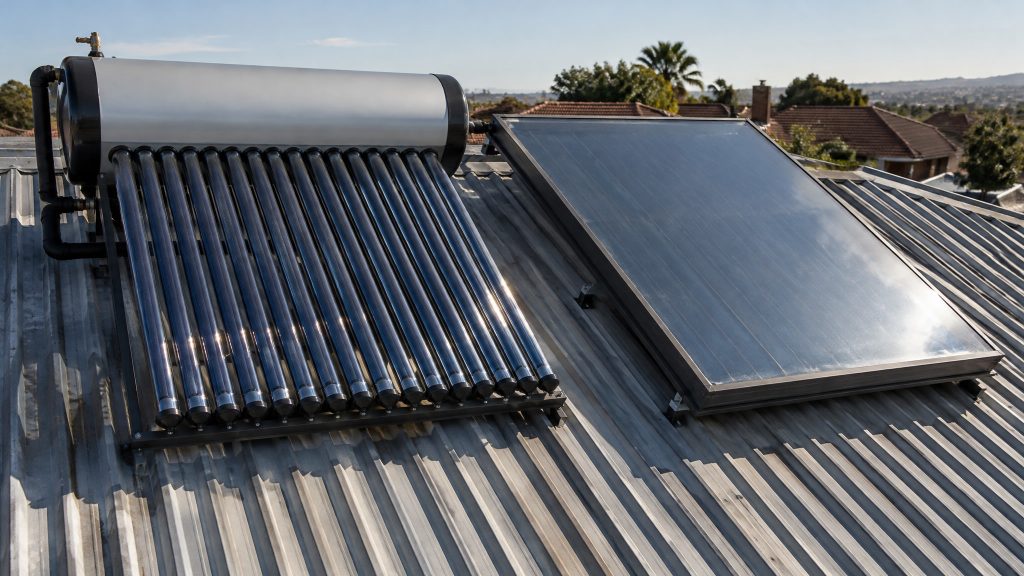
An evacuated tube collector is a row of glass tubes. Each tube has two glass walls with the air pumped out between them, and an absorber sits inside the inner wall. The vacuum stops air from carrying heat away from the absorber, much like the gap in a flask.
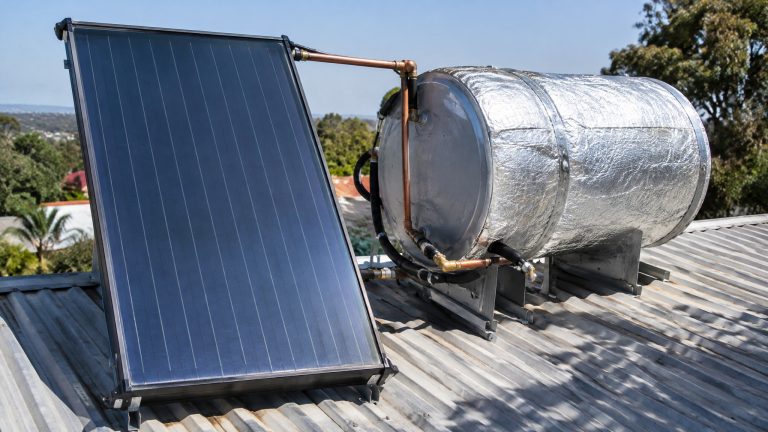
A flat plate collector is a glazed, insulated box. A dark absorber plate sits under a sheet of glass, with insulation behind it. The glass traps heat and the back insulation slows its escape, but the plate still sits in air, so it loses more heat when the weather turns cold.
That construction difference drives most of the performance gap between the two.
What a high pressure evacuated tube geyser combines
“High pressure evacuated tube geyser” bundles two separate choices into one phrase. The collector type, tube or flat plate, decides how heat is captured. The high-pressure rating describes the cylinder, meaning how it handles mains water pressure.
So a high-pressure geyser is not automatically a tube system, and a tube system is not automatically high pressure. You choose the pressure rating and the collector type independently, which is why the listed range below is described by size and route rather than by collector.
Solar geyser collector efficiency in cloudy and cold weather
Solar geyser collector efficiency means the useful heat a collector delivers compared with the sunlight that lands on it. Test-rated figures assume standard conditions that a real roof rarely matches, so treat any single number with caution. Your actual hot water also depends on tank size, how and when your household draws water, and the angle the collector is mounted at.
Why evacuated tubes hold heat on cold, overcast days
The vacuum between the glass walls removes the conductive and convective losses that air would otherwise carry away from the absorber. That is the main physical reason tubes keep their output in cold weather.
Tubes also accept low-angle and diffuse light well. On a frosty winter morning or under thin cloud, they keep delivering heat when a flat plate is already losing much of what it gathers.
Where flat plates keep pace on clear, mild days
On a clear, mild day the air around the collector is warm, so the flat plate loses little heat through its glazing and back insulation. The gap narrows sharply. If your area gets plenty of winter sun and few cold snaps, the flat plate’s weaker cold-weather performance rarely shows up.
This does not mean a flat plate matches a tube all year. It means the difference matters most in the months and places where the weather is cold or dull.
Evacuated tube solar geyser pros and cons, and how flat panel compares
Each type has strengths, and each weakness appears only under a particular condition. Here is how they line up.
Evacuated tube
- Pro: holds output better on cold, frosty and overcast days because of the vacuum.
- Pro: a damaged tube can often be replaced on its own.
- Con: a broken tube stops contributing, so hail or a stray impact costs you part of the collector.
- Con: the collector usually costs more upfront than a flat plate of similar size.
- Con: during long overcast spells even tubes deliver less. They hold up better than a flat plate, but they do not make sunshine.
Flat plate
- Pro: performs close to a tube on clear, mild days.
- Pro: the glazed panel is a single sealed unit, so there are no individual tubes to break.
- Con: loses more heat in frost and under long overcast spells, because air carries heat away from the plate.
- Con: a cracked panel, or condensation inside the glazing, usually means replacing the whole panel.
- Con: summer hail can crack the glass, which is why hail-resistant glazing is worth asking about.
If you are weighing the two, the pros and cons point the same way as the efficiency picture: tubes win where winters bite, and flat plates win where cost leads and the weather is kind.
Maintenance differences between the two collector types
Neither type is maintenance-free, and neither needs much. You can expect an occasional look at the collector and a few routine checks on the rest of the system.
Both types share the same basics. Check the pressure and temperature relief valve, check the controller if your system has one, and check the tank anode if one is fitted. Pump checks apply only where a pump is fitted, because thermosyphon complete systems circulate water without one. If yours does have a pump, it helps to know about pump replacement costs before it fails.
What fails first and how each type is repaired
On an evacuated tube system, the tube is usually the first thing to fail, typically after a knock or hail. A damaged tube can often be swapped on its own while the rest of the collector keeps working.
On a flat plate, the usual failures are a cracked panel or condensation inside the glazing. Either one normally means replacing the whole panel, because the sealed unit cannot be repaired piece by piece.
Ask your installer which parts they can replace individually before you commit to either type.
Price comparison by collector type and system route
Collector type is only one price driver. Tank size, roof work and whether you keep a sound electric geyser all move the total, often by more than the collector does. Listed prices below are approximate and change, so always confirm on the product page.
What really moves the upfront price
When you compare quotes, line them up like for like: same tank size, same route, same roof work. A cheap quote for a smaller tank or one that leaves out roof work will beat a fair quote for a larger, fully fitted system, and tells you nothing about the collector.
For the install side of a complete system, see what a complete solar geyser installation costs.
Complete systems versus conversions
The complete systems are the 150L high-pressure solar geyser at around ZAR 16,332, the 200L high-pressure solar geyser at around ZAR 19,325 and the 300L high-pressure solar geyser at around ZAR 28,085. Each is a thermosyphon system, so water circulates without a pump.
The conversions are listed as 100L, 150L, 200L and 300L High Pressure Solar Geyser Conversion, at around ZAR 11,825, ZAR 13,451, ZAR 15,449 and ZAR 19,482 respectively. Each conversion at 150L, 200L or 300L sits below its complete-system counterpart at the listed prices.
A conversion adds solar heating components to a compatible electric geyser you already own, instead of replacing a serviceable tank. That makes route a separate decision from collector type. For more on retrofit costs, read about conversion pricing for South African homes.
A conversion only suits you if your existing geyser is sound and matches a listed size. If the tank is old or leaking, a complete system is the safer route.
Which regions of South Africa suit each collector type
South Africa’s climate varies widely, so the collector that suits a home in Johannesburg may not suit one in Durban. Keep these as general guides, not guarantees, since local conditions vary even within a region.
Frosty inland and cool, cloudy winter areas
Frosty inland areas such as the Highveld, the Free State and the Eastern Cape highlands favour evacuated tubes, because cold nights and clear, freezing mornings are where the vacuum helps most. Cool, cloudy winter regions such as the Western Cape favour them too, since tubes cope better with diffuse light and low temperatures.
Freeze protection applies to either collector type, so ask your installer how the system you choose is protected. Summer hail on the Highveld is a second thing to raise: ask about hail-resistant glazing and about warranty terms before buying, whichever type you pick.
Warm, frost-free areas
In the largely frost-free Lowveld and on the KwaZulu-Natal north coast, a flat plate is a sensible choice when cost leads. Mild air means the plate loses little heat, and you save on the collector.
If you live somewhere warm but your household uses a lot of hot water, spend the extra money on tank size before you spend it on collector type.
Choosing the best solar geyser collector type for your home
There is no single best solar geyser collector type for every roof. Use a decision rule instead, and for the overall verdict, see our earlier evacuated tube versus flat panel verdict.
- Start with climate. Frost or cool, cloudy winters point to evacuated tubes. Warm, frost-free conditions with cost in front point to a flat plate.
- Pick the route. If you need a new geyser, or your current one is ageing, choose a complete system. If your electric geyser is sound and matches a listed size, a conversion keeps it and usually costs less, for example a 200L conversion for an existing electric geyser.
- Then size it. Daily hot-water use sets the size, not the collector. The 200L high-pressure solar geyser suits medium to larger households, such as family homes, townhouses and larger flats. The 300L high-pressure solar geyser for heavy daily use is described for guest houses, small lodges, shared accommodation and staff housing. For household guidance, read about choosing a solar geyser size for your family.
The listed range covers complete 150L, 200L and 300L systems and conversions from 100L to 300L, so every collector-type question ends in a size and route you can order.
To get matched properly, request a quote and tell us your current geyser size, your region and your roof details. The team will match a complete 150L, 200L or 300L high-pressure solar geyser, or a conversion for your existing electric geyser, to your home.
Frequently asked questions
Which is the best solar hot water system?
No single system is best everywhere. Frosty or cool, cloudy areas lean towards evacuated tubes, while warm, frost-free areas can use a flat plate when cost leads. After that, pick a complete system if you need a new geyser, or a conversion if your electric geyser is still sound.
What are the standard sizes of geysers in South Africa?
The listed range here runs from 100L to 300L. Complete high-pressure solar geysers come in 150L, 200L and 300L, and conversions come in 100L, 150L, 200L and 300L. Daily hot-water use sets the right size, so a larger household or guest house should look at the larger tanks.
Is a heat pump better than a geyser?
A heat pump is a different technology, so it is not a like-for-like swap for a solar geyser. It runs on electricity to move heat into the water, whereas a solar geyser heats water with the sun and uses electricity only as backup. If cutting electricity use is your goal, the listed solar geysers and conversions are the options this article covers.
Does high pressure mean the geyser uses evacuated tubes?
No. High pressure describes how the cylinder handles mains water pressure. The collector type, tube or flat plate, is a separate choice that decides how the heat is captured.