Ask three installers for the best heat pump size for a 4-bedroom house in South Africa and you may get three different answers. Most online guides size by floor area or “tonnage”, which is how you size an air conditioner. That logic does not carry over to a hot-water heat pump.
This guide starts from who lives in the house and how they use hot water. Then it maps three ITS models, the 5.4HD, the 6.3HDSuper and the 7.6HD, to the household each one suits. Read the mapping, find your household, and go straight to the matching listing.
Heat Pump Sizing for Your Household: Demand Comes Before Bedrooms
A four-bedroom house can hold two people or seven. Bedroom count is only a rough proxy, and installers who size heat pumps usually start from the number of regular hot-water users, the peak-hour draw and the storage volume. You will get a better answer from your own morning routine than from the estate agent’s listing.
Count the People Who Use Hot Water Every Day
Count the people who shower or bathe daily, then note anyone who takes a bath instead of a shower. A couple with two school-age children is a very different load from a family with three teenagers and a live-in helper, even though the house is identical.
Add the habits that are easy to forget. Daily laundry on warm cycles, a dishwasher, and a home office with people coming and going all add to the total.
If you are not sure how many litres of storage your household needs, how to choose a geyser size for your family covers the storage side in detail.
Plan Around the Morning Peak, Not the Daily Average
The daily average hides the problem. What decides whether a unit copes is the one busy hour when everyone wants hot water at once.
Picture a typical weekday in a four-bedroom family home. Three people shower between 6:30 and 7:30, the dishwasher runs after breakfast, and the tank has to recover before the next person steps in. A unit that handles the whole day comfortably can still leave the last person in the queue with lukewarm water.
That peak sets the load that the tank and the kW rating must cover together. Size for the busiest hour you regularly have, not for a quiet Sunday.
Heat Pump kW Size Explained: What the Rating Controls
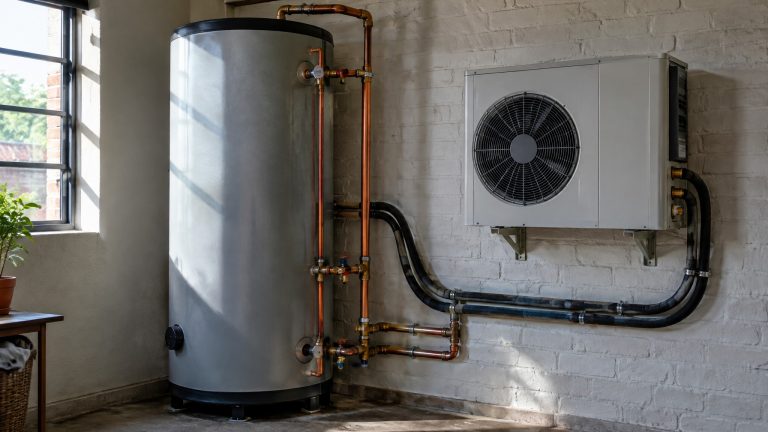
The ITS units in this guide are air-to-water heat pumps for domestic hot water. They pull heat from the air and move it into your water, so room-sizing charts and air-conditioner tonnage tables do not apply to them.
The kW figure is heating capacity. A higher rating means the unit puts heat into the water faster, so the tank recovers sooner after the morning peak, and that is the whole job of the number.
Air-to-water units also deliver less heat on a cold winter morning than on a mild day. Check your choice against the coldest conditions your household regularly sees, not the mildest, because a unit that is just enough in March can struggle in July.
kW Rating Versus Tank Volume
Tank volume, not kW, decides how much hot water is stored. A large tank with a small heat pump holds plenty of hot water at the start of the day but takes a long time to refill. A small tank with a big heat pump recovers quickly but can run out mid-queue.
A bigger kW rating will not fix a tank that is too small for your household. You need both numbers to fit the way you live, and the match matters more than either figure alone.
If you are swapping out an electric geyser, the guide to the domestic heat pump as a geyser replacement explains what changes and what stays. Note the volume of your existing geyser first, because it is the starting point for both conversations.
Standard vs High-Temperature Heat Pumps in South Africa
Sizing has two questions, not one. The first is how much heat you need, which is the kW rating. The second is how hot the stored water should be, which is the choice between a standard unit and a high-temperature heat pump in South Africa’s range of options.
What the HDSuper Label Means in the ITS Range
The HDSuper suffix marks the high-temperature line. The ITS-6.3HDSuper is listed as a high-temperature residential air-to-water heat pump from the ITS Super series, designed for larger domestic hot-water requirements. The ITS-5.4HD and ITS-7.6HD are listed as standard domestic heat pumps without that label.
Water stored hotter gives you more usable hot water from the same tank. At the tap it is mixed down with cold water, and hotter stored water means less hot is needed in each mix, so the tank lasts longer through a busy morning.
When a Family Home Benefits From High-Temperature Output
High-temperature output earns its place when your tank is not large but your morning demand is. It also helps when several people draw hot water back to back and you want the stored volume to stretch as far as it can.
It matters less in a house where showers are spread across the day. If hot-water use is light or staggered, a standard unit usually does the job and the extra temperature goes unused.
Heat Pump Size for a 4-Bedroom House: Mapping the ITS Models
Three listings cover the range most four-bedroom households need: the ITS-5.4HD 5.4kW Domestic Heat Pump with Wi-Fi, the ITS-6.3HDSuper 6.3kW High-Temperature Domestic Heat Pump with Wi-Fi and the ITS-7.6HD 7.6kW Domestic Heat Pump with Wi-Fi. All three list built-in Wi-Fi, so connectivity does not separate them. The comparison rests on capacity and temperature.
The listings describe each unit in its own words, and that wording is the best guide. The ITS-5.4HD is a domestic heat pump for efficient hot-water heating. The ITS-6.3HDSuper is a high-temperature residential unit for larger domestic hot-water requirements. The ITS-7.6HD is a high-capacity unit for larger domestic hot-water systems.
ITS 5.4HD vs 7.6HD: Which Suits Your Household
The ITS-5.4HD for lighter hot-water use suits a four-bedroom house where few people live or where showers are staggered through the morning. Think of a couple with one child, or a family where school and work starts are spread across two hours. Recovery between showers is not a problem when the draws never overlap.
The 7.6HD sits at the other end. It suits a household where several people need hot water at the same time, and where waiting for the tank to recover is not an option.
For most four-bedroom homes with regular daily showers, the ITS-6.3HDSuper high-temperature model is the natural starting point. It sits between the two on capacity and adds the high-temperature output, which stretches the stored volume through the morning rush.
Heat Pump for a Large Family: When the 7.6HD Earns Its Place
A heat pump for a large family has to handle overlap. If four or five people are washing within the same hour, plus a dishwasher or washing machine, the highest kW rating gives the fastest recovery. That is the case for the ITS-7.6HD for large households.
There is a trade-off, and it is worth knowing before you buy. The ITS-7.6HD is listed as a standard unit, not a high-temperature one, while the ITS-6.3HDSuper carries the high-temperature label with a lower kW rating. A large family that also wants higher stored temperature has to decide which matters more: faster recovery or hotter storage.
If your tank is generous, the 7.6HD’s capacity usually wins. If your tank is modest and your mornings are tight, the 6.3HDSuper’s hotter water may stretch further. A sizing check, described at the end of this guide, settles the question for your specific house.
Common Heat Pump Sizing Mistakes to Avoid
Most sizing problems come from four habits. You can avoid all of them by checking your choice against your real mornings.
- Sizing by bedroom count alone. Four bedrooms say nothing about how many people use hot water or when.
- Ignoring tank volume. The heat pump and the tank work as a pair, and a mismatch in either direction leaves you short.
- Planning for a mild winter. Air-to-water units give less heat on cold mornings, so size for the coldest weeks.
- Overlooking simultaneous use. Two showers and a dishwasher at once is a different load from the same use spread across the morning.
None of this means bigger is always better. A heat pump sized well beyond your demand adds cost without improving a single shower.
Undersizing to Save Money
Buying the smallest unit to save money is the mistake people regret most. The residential listings sit fairly close together on price, so the saving from stepping down a size may be modest compared with what you give up in recovery speed.
An undersized unit also has to run longer to do the same job, and that can show up on your electricity bill. You may end up paying more month after month to save a little once.
Planning an Upgrade Path as Your Household Grows
A growing household usually means replacing the heat pump, not adding a second one. So choose for the household you expect over the next few years, not only the one you have today. Teenagers who currently share a bathroom will soon shower at the same hour.
The path is straightforward. A family that starts on the ITS-5.4HD while the children are small can move to the ITS-6.3HDSuper or the ITS-7.6HD as occupancy rises and showers begin to overlap. Moving up is simpler when the first installation already left room for it.
At installation, check three things: mounting space for a larger unit, the power supply, and the tank. Fitting these for the bigger model from the start costs far less than reworking them later.
Once the unit is in, keep it performing as sized. Our heat pump maintenance checklist lists what to look at and how often.
Heat Pump Cost for a 4-Bedroom House and How to Get a Sizing Check
The installed cost depends on the model, the tank, your site and the installation work. Two houses with the same heat pump can have quite different totals, which is why a single quoted figure would mislead you. The ITS heat pump price list carries the current listings, so check it rather than trust any number in an article.
If you recognise your household in the mapping above, go straight to the matching listing: the ITS-5.4HD for lighter use, the ITS-6.3HDSuper for a typical four-bedroom family, or the ITS-7.6HD for heavy simultaneous draw.
If you are between two models, or your house does not fit neatly, request a sizing check. Send us:
- your household size.
- the number of bathrooms.
- the volume of your existing geyser.
- and your power supply details.
With those four details we can point you to the right unit instead of leaving you to guess. This guide covers domestic hot-water heating only, and it does not replace a site visit if your installation is unusual.
Frequently asked questions
How much is a heat pump for a 4-bedroom house?
The unit price depends on the model you need, and the installed total also depends on the tank, your site and the installation work. The ITS heat pump price list carries the current listings for the ITS-5.4HD, ITS-6.3HDSuper and ITS-7.6HD. Check the listing for today’s price rather than rely on a figure written into an article.
Why is my electric bill so high with a heat pump?
The most common cause is an undersized unit, which has to run for longer to heat the same water. A tank that does not match your morning demand and sizing for a mild winter can do the same on cold mornings. Send us your household size, bathroom count, geyser volume and power supply details and we can check whether the unit fits.
Does every 4-bedroom house need the ITS-6.3HDSuper?
No. The ITS-6.3HDSuper is the natural starting point for a four-bedroom house with regular daily showers, but a household with lighter or staggered use can suit the ITS-5.4HD. A large family with heavy simultaneous draw may need the ITS-7.6HD instead.
Will a higher kW rating make up for a small tank?
Not fully. The kW rating sets how quickly water is reheated, while the tank volume sets how much hot water is stored. A large unit on a small tank recovers fast but can still run out during a busy morning, so the two need to be matched.