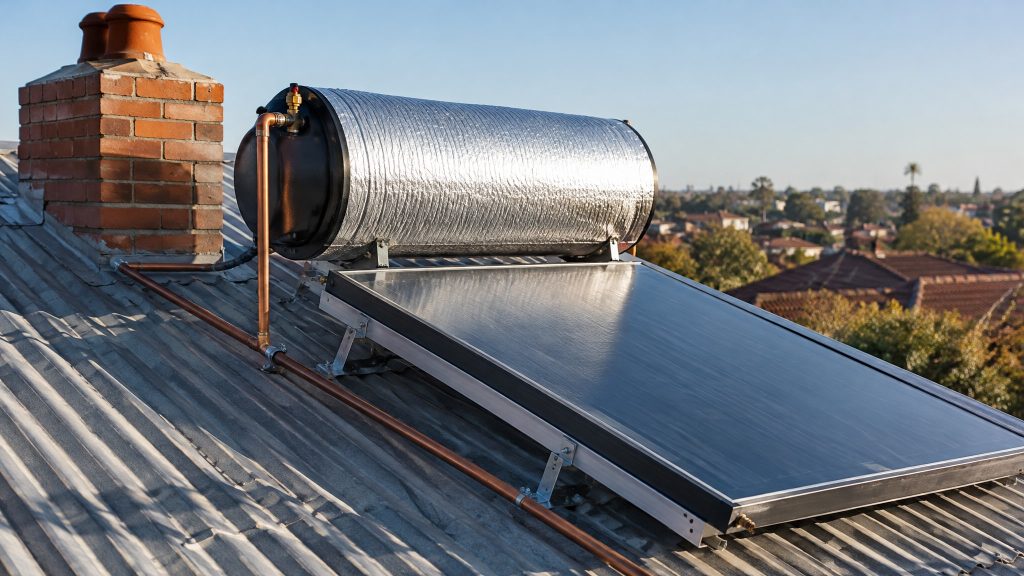
Most solar geyser quotes start with a litre figure, and most buyers pick it by guesswork. Go too small and the last person in the queue gets a cold shower. Go too large and you pay for a tank your roof and your habits never put to work.
This guide explains how to choose a solar geyser size for your family before you look at price or brand. It maps household size to the 100L, 150L, 200L and 300L complete systems, and it shows why the busiest hour of your day matters more than the average.
Solar Geyser Capacity: What the Litre Rating Means
A solar geyser’s litre rating is the volume of hot water the tank stores, ready to draw off at the taps. That is all it measures. It says nothing about how fast water leaves the tap, and nothing about how hard it pushes out, because flow and pressure belong to your plumbing and to the type of system.
Think of the tank as a hot water bank balance. Every shower, bath and kitchen draw withdraws from it, and the sun and any backup heating deposit into it. When the balance runs low, the water at the tap turns lukewarm.
So how many litres should a family’s geyser hold? The short answer: enough to cover the hours when several people draw hot water together, and no more than your roof can heat. The complete systems in this range run from 100L for a flat or cottage up to 300L for shared properties, and the sections below show where your home sits on that scale.
For a wider capacity guide to the cost side, see solar geyser installation costs in South Africa. This article stays on sizing.
Choosing a Solar Geyser Size for Your Family
Household size gives you a starting tier, but bathroom habits decide whether that tier holds up. Two families of four can need different tanks.
Matching Household Size to the 100L–300L Range
The four complete systems are described on their product pages like this:
- 100L: a compact option for smaller households, flats, cottages and properties with moderate daily hot water demand.
- 150L: for smaller homes, townhouses, flats and family properties that need reliable daily hot water. The 150L high-pressure solar geyser for smaller family homes is the middle step.
- 200L: for medium to larger households and family homes where several people use hot water.
- 300L: for bigger households, guest houses, small lodges and shared accommodation with heavy daily demand.
Take a four-person household as the worked case. Four people sit between the 150L and 200L descriptions, which is why headcount alone can’t settle it. If two bathrooms let people wash at different times, the 150L is a sensible fit. If everyone showers in the same window before work and school, or someone takes a daily bath, the 200L is the safer choice.
Small-unit questions get the same test. Does a 10-litre tank cover three people? Ignore the headline figure and picture all three washing in the same half hour. A single shower can draw down much of a 10-litre tank, so the second person gets lukewarm water and the third gets none. A tank that small suits a basin or a kitchen tap, not showers for a household.
Even the smallest tank in this range, the 100L, holds ten times that volume, and it is still pitched at smaller households with moderate demand.
100L vs 200L Solar Geyser: When the Step-Up Pays
The jump from 100L to 200L doubles the stored hot water. It pays when several people use hot water in the same window, not simply because the house has more people in it.

A couple who shower at different times, with no bath and a quick kitchen draw, rarely empty a 100L tank. Three or four people who all wash between 6:30 and 7:30 will. For that second household, the 200L high-pressure solar geyser keeps the last shower as warm as the first.
The 150L sits between the two. Choose it when you have a small family, a townhouse bathroom or two, and some spread in when people wash. It gives you headroom the 100L lacks without the roof demands of the larger tank.
This sizing logic does not replace a site visit. An installer still has to confirm that your roof and plumbing can take the tank you pick.
Size for Peak Hot Water Demand, Not the Daily Average
A family might use a certain amount of hot water across a whole day and still run out at 7:15 a.m. The tank has to cover the busiest overlap of showers, baths and kitchen draws, because that is the moment it gets emptied.
Counting the Morning Peak
Walk a four-person household through a typical weekday. At 6:30 the first teenager showers. Ten minutes later a parent follows, then a second child, then the last adult. Meanwhile someone rinses breakfast dishes with hot water from the kitchen tap.
That is four showers and a kitchen draw in about an hour. In the evening the same people wash across three hours, with a gap between each draw, so the evening is easy. The morning sets the size.
Count your own peak this way. Write down who draws hot water in your busiest hour, how many showers or baths that includes, and whether the dishwasher or washing machine takes hot water at the same time. If the list is long, step up a tier.
Stored water gets a head start overnight. What you draw at breakfast was heated the day before and kept in the tank, so the morning is where an undersized tank shows up first.
Planning for Cloudy Spells Without Oversizing
Winter brings lower sun and colder water coming in from the mains, so the tank heats more slowly. It is tempting to buy a bigger tank “for the weather”, but that does not work, because a larger tank full of cold water is simply a larger tank to heat.
A bigger tank also cannot make the sun appear. It only stores more of whatever heat the collector delivered.
Ask instead about two things. First, what backup heating the system has for cloudy spells, and how it is controlled. Second, whether the collector area is large enough for the tank you want. Those two answers do more for winter showers than extra litres do.
High-Pressure vs Low-Pressure: What Changes at the Tap
Pressure and capacity are separate choices. Litres tell you how much hot water is stored. Pressure governs how that water reaches the outlets, so you can pick any tank size and still have to decide how it gets to the tap.
Every system in this range is high-pressure. That means the question is not which type to choose but whether your property’s mains supply suits one. When you are choosing a geyser size in South Africa, settle the pressure question before you compare litres, because a property that cannot take a high-pressure system changes your whole shortlist.
Checking Mains Pressure Before You Order
Supply varies by municipality and even by suburb, so the property in front of you matters more than any general rule. Some areas also impose limits on pressure, and your installer can explain what applies at your address.
Ask your installer to confirm the mains pressure at your property before you order. If you are on a borehole or a private supply, say so, because that changes the answer.
This check protects you from the worst outcome: buying the right size tank and discovering it does not suit your water supply.
Matching the Tank to Your Roof Space
A bigger tank needs enough collector area to heat it, and a roof that can carry the weight. In practice the roof often sets the ceiling before the household does.
Collector Area, Orientation and Roof Fit
Picture a townhouse with a small, partly shaded roof section. The family wants a 200L tank, but the collector area available is limited. The result is slow heating: the tank is large, the collector is small, and the water never reaches the temperature the family expects. A smaller tank that the collector can fully heat would serve them better.
In South Africa collectors generally face north, which gives them the most sun across the day. Shade from trees, a neighbouring building or a parapet wall cuts output, even if it only covers the collector for part of the day.
Walk onto your roof, or look at it on a clear day, and check three things: which way the best section faces, how much of it stays shaded through the day, and whether the structure can take the tank and collector.
If the roof cannot take a large array, weigh up a heat pump or solar geyser before committing to a size you cannot fit.
Converting an Existing 100L, 150L or 200L Geyser
If you already have an electric geyser, you may not need a new tank at all. The 100L High Pressure Solar Geyser Conversion, 150L High Pressure Solar Geyser Conversion and 200L High Pressure Solar Geyser Conversion retrofit an existing electric geyser of the matching size. The 100L and 200L pages describe this as a way to cut electricity use without replacing a serviceable tank. Check the 150L page for its details in the same way.
So your first job is to read the capacity on your current geyser and judge its condition. A geyser that is leaking or near the end of its life is a poor candidate, and a 150L conversion does not suit a 200L tank. If you are unsure, read our guide on whether to repair or replace your current geyser. For costs, see the conversion pricing for an existing geyser.
A conversion keeps the tank you have, so it does not let you change size. If your household has outgrown the tank, a complete system in a larger tier is the better route.
Sizing Mistakes to Avoid
Most oversized and undersized geysers trace back to the same handful of errors.
Sizing to the daily average. The average hides the morning peak, and the peak is when the tank runs out.
Treating headcount as the only input. Four people who wash at staggered times need less than four people who all shower at once.
Ignoring overlapping showers and baths. One bath on top of two showers can drain a tank that coped with the showers alone.
Choosing by brand or price before litres. Fix the tier first, then compare geyser brands once the size is set.
Converting a geyser without checking its capacity. A conversion has to match the tank you already own, so confirm the litres and the condition first.
Oversizing a tank the collector cannot heat. A big tank on a small or shaded collector heats slowly, and you pay for litres you never get warm.
Confirm Your Size Before You Order
By now you should have a likely tier, a view of your morning peak, and a sense of what your roof allows. One last check with an installer turns that into a confirmed size.
What to Have Ready for a Sizing Check
Gather these before you ask for a quote:
- The number of people in the household, and how many shower or bathe in your busiest hour.
- Your peak-use habits: baths, early starts, hot-water appliances running at the same time.
- The size of your existing geyser, if you are thinking of converting.
- Your roof’s orientation, the space available and any shading.
- Your mains pressure, or the details of your water supply.
With those details an installer can recommend a tier rather than guess. A four-person household with an overlapping morning peak and a clear north-facing roof is a typical fit for the 200L, and a quieter, staggered household may sit at the 150L.
Request a quote for the tier your household and roof support, and include your existing geyser’s size if you plan to convert. For pricing, the cost guides linked above give the figures, so this article leaves them out.