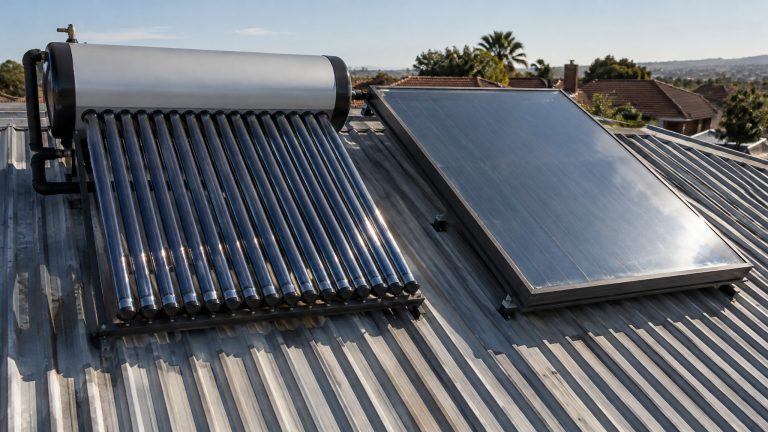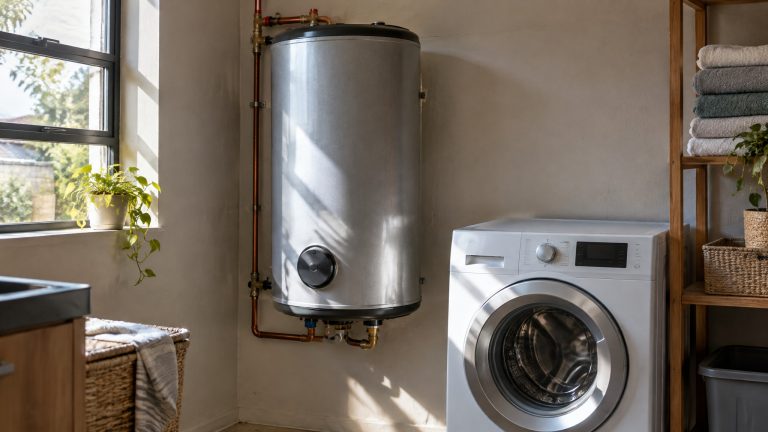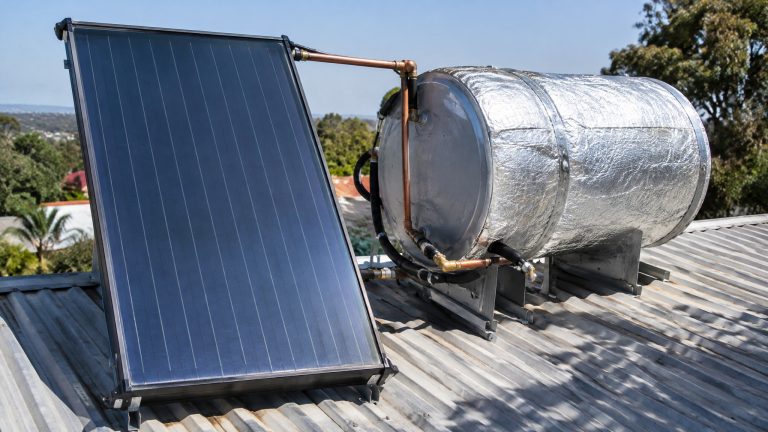
Your geyser has stopped heating, and the quote for another electric geyser is on the table. Before you sign it, consider a domestic heat pump for geyser replacement, because in many homes the failed part is only the element or thermostat, and a heat pump can take over that job.
This guide covers what an ITS domestic heat pump replaces and what it does not. It also covers how to check your tank, how to size a unit for a two-bathroom house, which electrical and plumbing changes the swap needs, and where the cost gap against a plain electric geyser comes from.
Domestic Heat Pumps for Geyser Replacement: What Stays and What Goes
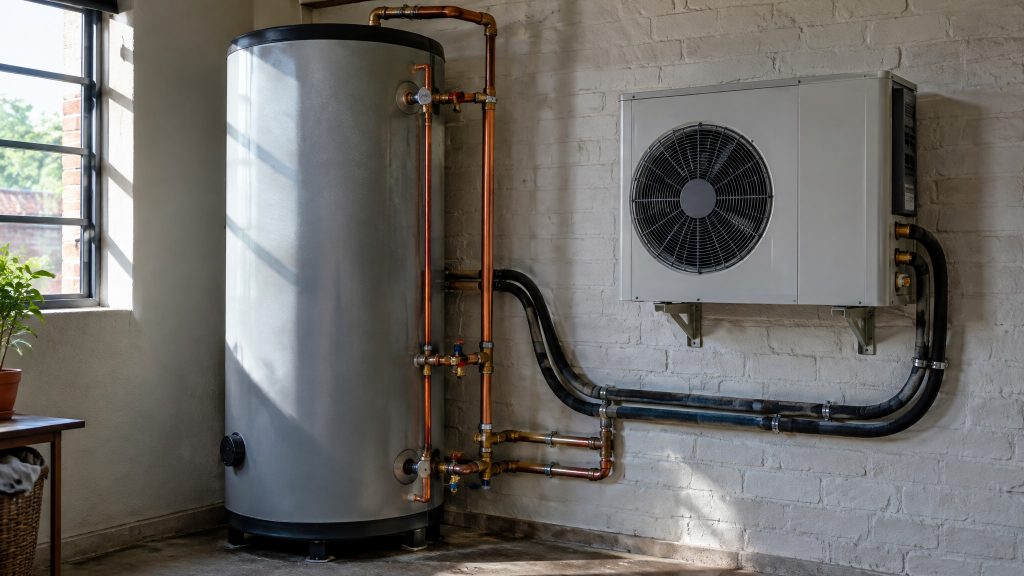
An ITS domestic unit is an air-to-water heat pump. It pulls heat out of the outside air, passes it into water, and keeps that water hot in a storage tank. The tank still does the storing. The heat pump simply replaces the electric element as the thing that makes the heat.
So what about using a heat pump instead of a geyser? The honest answer is that you swap the heating method, not the whole geyser. ITS describes the ITS-3.6HD and ITS-5.4HD as reducing reliance on a conventional geyser element, and it rates the 3.6HD for geysers up to approximately 200 litres. Nothing on those pages promises that the tank disappears.
What goes is the element’s heating role, along with most of the electricity it burns. What stays is a sound, correctly sized storage tank, plus a fair bit of new plumbing and wiring around it.
A heat pump moves heat from the air into the water instead of making heat with a resistance element. That is why it uses less electricity for the same amount of hot water. It also has two limits you should know about: its output and efficiency fall in cold weather, and it needs power to run. Water already in the tank stays usable for a while after a power cut, but the unit will not reheat it until the power returns.
This is not the right route if your tank is leaking, or if you want a plug-in swap you can finish in an afternoon. The next sections explain why.
Checking Whether Your Existing Geyser Tank Is Compatible
Tank condition and tank size decide everything else. Start there, before you look at any model or price.
Retrofitting a Heat Pump to a Sound Existing Geyser
The simple case is a sound tank with a failed element or thermostat. The tank holds water, shows no rust weeping from the seams, and simply stopped heating. Here the heat pump takes over the element’s job, not the tank’s, and the existing tank stays in service.
That is what a heat pump retrofit on an existing geyser means in practice. Your installer connects the heat pump to the tank and the tank carries on storing hot water.
Read the label on the tank first. The capacity in litres is printed on it, usually along with the manufacture date or serial number. The ITS-3.6HD product page describes the unit as suitable for geysers of up to approximately 200 litres, so a 150-litre or 200-litre tank fits that check, while a larger tank points you to a bigger model.
Age matters as much as capacity. A tank that is already old may fail soon after you spend money on a heat pump, so an installer will want to look at its condition on site. If you are still weighing repair against replacement, the geyser repair or replace decision guide walks through that choice.
Also check how the tank is supplied with water. Mains-pressure and roof-tank (low-pressure) supplies behave differently, and the valves, pipework and connections must suit whichever you have. Tell the installer which one your house uses, because it affects the plumbing work and the quote.
When a Failed Tank Must Be Replaced First
A tank that is leaking or has split cannot be fixed by fitting a heat pump. The heat pump heats water; it cannot hold it. If the tank has failed, it is replaced first, and the heat pump is connected to the new tank.
Signs that point to a failed tank rather than a failed element include water pooling under the geyser, a wet ceiling beneath it, and rust-coloured water. An element or thermostat fault usually looks different: the water simply stays cold or only lukewarm.
If the tank has to go anyway, the heat pump is still a valid choice. You are then pricing a new tank plus a heat pump instead of a new electric geyser, and the cost section below sets out how those compare.
Sizing an ITS Domestic Heat Pump for a Two-Bathroom House
Bathroom count is a poor way to size a heat pump. A two-bathroom house with two adults can use far less hot water than one with four people showering before school, so tank size and morning demand tell you more than the number of taps.
Best Heat Pump for a Two-Bathroom House: Matching Model to Tank and Demand
ITS sells five residential models. Compare them using the wording on their product pages, and let the installer confirm the final pick on site.
- ITS-3.6HD domestic heat pump: the entry point at 3.6 kW, suitable for geysers up to approximately 200 litres.
- ITS-4.5HDSuper high-temperature model: a 4.5 kW unit from the ITS Super series, with an internal bronze circulation pump and a digital controller with built-in Wi-Fi and app control.
- ITS-5.4HD with Wi-Fi control: a 5.4 kW unit with an internal bronze circulation pump and current-generation Wi-Fi control.
- ITS-6.3HDSuper for larger hot-water demand: a 6.3 kW Super series unit that ITS designs for larger domestic hot-water requirements.
- ITS-7.6HD for larger domestic systems: a 7.6 kW unit that ITS describes as high-capacity, for larger domestic hot-water systems.
The pages give a tank limit only for the ITS-3.6HD. For the others, treat the kilowatt rating and the “larger demand” wording as a guide, and let the installer match the unit to your tank rather than guessing from the numbers.
In practice, a typical two-bathroom home with one geyser of around 150 to 200 litres and a modest morning rush is the natural fit for the 3.6HD. If the household is bigger, showers run back to back, or the tank is larger than 200 litres, the higher-rated models come into play. The two Super-series units are listed as high-temperature models, which may matter if you want hotter stored water.
Two things will not help you choose. One is the bathroom count on its own. The other is picking the biggest unit “to be safe”: a larger heat pump costs more upfront, and a tank that is too small will not use the extra capacity.
One Heat Pump or Two When the Plumbing Is Split
Many two-bathroom houses have two geysers, one for each end of the house, each feeding its own taps. When the plumbing is split like that, you usually need one heat pump per geyser, because each unit heats the tank it is connected to.
Some homes appear split but are not. A single geyser may feed both bathrooms through long pipe runs, or an older alteration may have added a second tank for one wing only. You cannot always tell by looking at the taps.
This is what a site check settles. The installer traces which geyser feeds which outlets, reads each tank’s label, and counts the units you need. If you send a photo of each tank and its label before the visit, the quote comes together faster.
Electrical and Plumbing Changes a Heat Pump Swap Needs
A heat pump is not a plug-in swap. It is a small piece of plant that crosses the plumbing and electrical trades, which is why the installer versus handyman for geyser fitting question matters more here than it does for a like-for-like geyser.
Electrical Changes: Dedicated Supply, Isolator and Certificate of Compliance
Start with the supply. The heat pump needs its own dedicated circuit from the distribution board, with an isolator near the unit so it can be switched off safely for service.
Then there is the old element circuit. Your electrician either keeps it as a backup for the element or isolates it so that only the heat pump heats the tank. The installer decides this on site, based on your tank, your board and how you want the system to behave.
A registered electrician must do this work. South African electrical work on a new supply is normally certified with a Certificate of Compliance, and the heat pump’s dedicated circuit belongs in that process. It is not a DIY job, and you should not accept a handshake instead of the certificate. Check current requirements with your electrician, because your insurer or a future buyer may ask to see it.
Give the installer the details of your supply up front: the size of your distribution board, how much spare capacity it has, and how far it sits from the proposed unit position. A long cable run adds cost.
Plumbing Changes: Tank Connections, Valves and Outdoor Unit Siting
On the water side, the heat pump is connected to the tank through new pipework. Expect tank connections, isolation valves so the unit can be serviced without draining the tank, and a non-return valve to stop water flowing the wrong way. The temperature-and-pressure relief arrangement on the tank must also stay in order, and the installer checks that it is.
The ITS-4.5HDSuper, ITS-5.4HD, ITS-6.3HDSuper and ITS-7.6HD pages each describe an internal bronze circulation pump. That means the pump that moves water between tank and heat pump is built into those units, so you do not usually need to plan a separate external pump for them. The ITS-3.6HD page does not describe one, so ask the installer what that model needs.
The outdoor unit needs its own space. It draws in air, so it needs clearance on its sides and a spot where the airflow is not blocked by a wall, a hedge or a stack of stored boxes. It also produces condensate as it runs, so it needs a drain route for that water rather than a spot that floods a path or a doorstep.
Distance between the unit and the tank is another cost driver. The nearer they sit, the shorter and cheaper the pipework. A good site visit often ends with the installer moving your proposed unit position a metre or two for exactly this reason.
Heat Pump Geyser Replacement Cost Versus a Like-for-Like Electric Geyser
You have three realistic routes, and each costs differently. The first is an element or thermostat repair on a sound tank, which is the cheapest option and keeps the old running costs. The second is a like-for-like electric geyser, the simplest replacement for a failed tank. The third is a heat pump on a sound or new tank, which costs the most upfront.
For a heat pump, the premium over a plain electric geyser comes from three places. First, the unit itself. Second, the extra pipework between tank and outdoor unit. Third, the electrical work: a dedicated circuit, an isolator and the Certificate of Compliance. If your tank is sound and stays, you skip the cost of a new tank, which narrows the gap noticeably.
Model prices change, so check the current ITS heat pump price list rather than relying on a number in an article. The written quote then adds the installation items specific to your house.
What Drives the Upfront Difference and the Running-Cost Saving
The upfront difference moves with five things: whether the tank is reused, how far the pipework runs, how much electrical work the board needs, which model fits your demand, and whether you need one unit or two.
The running-cost saving moves with different things. Your electricity tariff matters, because the higher the price per unit, the more each saved kilowatt-hour is worth. How much hot water your household uses matters too, since a home that barely uses its geyser saves little. Winter performance matters as well, because the unit’s output and efficiency fall in cold weather.
I will not put a payback figure on this, because it would be a guess. Whether the saving justifies the upfront premium depends on your bills and your household. A heat pump pays off most in homes with steady, heavy hot-water use. If you are leaving soon, or your geyser sees light use, a like-for-like replacement may be the better buy.
Wi-Fi and App Control on ITS Domestic Heat Pumps
Every residential model carries Wi-Fi in its listed name. The ITS-5.4HD and ITS-7.6HD pages describe current-generation Wi-Fi control, and the ITS-4.5HDSuper page describes an advanced digital controller with built-in Wi-Fi and app control.
For you as an owner, that means you can reach the unit from your phone rather than going outside to its controller. Read each product page for the exact app features, because they are worded per model and this article does not add to them.
Check your router signal at the controller’s location before installation. A heat pump often sits at the far end of the property, on an outside wall, and a Wi-Fi signal that is strong in the lounge can be weak there. If the signal is poor, tell the installer so a range extender or a different unit position can be discussed.
Next Step: Book a Site Check for Your Geyser Swap
The quickest way to a firm answer is a site check with a written quote. The installer confirms the model, the compatibility of your tank and the full cost on site, which no article can do for you.
Gather these before you request it:
- The tank capacity in litres, read from the geyser label
- The age of the tank
- The failure symptom: no hot water, lukewarm water, tripping, or a leak
- The number of bathrooms, and whether you have one geyser or two
- Your electrical supply details, including the distribution board and its spare capacity
Send them with your request for a site check and written quote for an ITS domestic heat pump swap. A photo of the geyser label and the board helps.
Frequently asked questions
How much does a heat pump hot water system cost in South Africa?
The unit price on the ITS residential product pages runs from around ZAR 13,000 for the ITS-3.6HD to around ZAR 17,000 for the ITS-6.3HDSuper, and these figures change. Installation comes on top: pipework, the dedicated electrical circuit, the isolator and the Certificate of Compliance. A new tank adds more if yours has failed, so the written quote after a site check is the number to rely on.
Will a heat pump work during a power cut?
No. The heat pump needs electricity to run, so it stops heating when the power is off. The water already stored in the tank stays usable for a while, but the unit will not reheat it until power returns.
Does a heat pump still work well in winter?
It still works, but its heating output and efficiency fall in cold weather. You will see the biggest saving over a milder season and a smaller one in the coldest weeks. The installer can talk through how this affects your area and your household’s hot-water use.
Can I keep my old geyser element as a backup?
Sometimes. The electrician either keeps the old element circuit as a backup or isolates it so only the heat pump heats the tank. The installer decides which on site, based on your tank, your distribution board and how you want the system to behave.