If you own a home built before the mid-2000s in South Africa, there’s a good chance your walls hide copper pipes. For decades, copper was the default choice for residential plumbing, durable, reliable, and widely trusted. But the debate over old copper pipes vs modern plastic plumbing has shifted sharply in recent years, driven by copper theft, hard water corrosion, and falling plastic pipe costs. This guide gives South African homeowners a clear, practical comparison so you can make an informed decision about your plumbing in 2026.
How Copper and Plastic Pipes Are Built to Perform
What makes copper pipe durable
Copper is a dense, naturally antimicrobial metal that handles pressure and heat well. Standard 15 mm and 22 mm residential copper pipes in South Africa typically carry a pressure rating of around 1 200–1 500 kPa and can handle temperatures up to 120 °C continuously. That makes copper well-suited for both cold and hot water lines, including connections to geysers.
Wall thickness determines strength. Type A (thick wall) is used for exposed or high-pressure runs; Type B (thin wall) suits concealed, lower-pressure applications. Properly installed copper in a moderate climate can last 50 years or more.
How modern plastic plumbing (uPVC, CPVC, PEX) works
Modern plastic pipes fall into three main categories relevant to South African residential plumbing:
- uPVC (unplasticised polyvinyl chloride) is rigid, cost-effective, and approved for cold water supply and drainage. It’s the most common plastic pipe in South African hardware stores and is SANS-approved for potable water use.
- CPVC (chlorinated polyvinyl chloride) tolerates higher temperatures, typically up to 93 °C, which makes it suitable for hot water lines. It’s increasingly the go-to choice for plumbers replacing copper in older homes.
- PEX (cross-linked polyethylene) is flexible, resists freezing and bursting under pressure spikes, and installs faster than rigid pipe. It’s gaining popularity in new builds and remodelling projects.
On raw performance, the gap between PVC and copper is narrower than most homeowners expect. CPVC matches copper’s pressure rating for residential applications, and PEX handles pressure spikes better because it flexes rather than splits. The real differences show up not in the lab, but in actual South African conditions.
Copper Pipe Corrosion Problems in South Africa’s Climate
Hard water and its effect on copper pipe lifespan
South Africa has some of the hardest municipal water in the world. In Gauteng, Limpopo, and the Karoo, total dissolved solids (TDS) in municipal water regularly exceed 500 mg/L. This mineral-rich water accelerates a specific failure mode in copper: pitting corrosion.
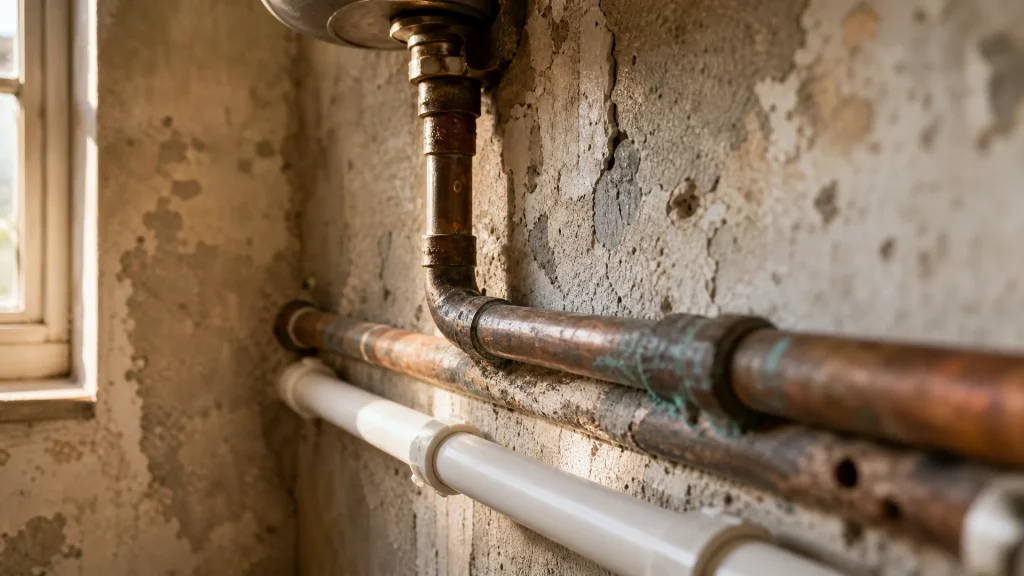
Pitting corrosion attacks the pipe wall from the inside, creating pinhole leaks that are difficult to detect until water damage is already visible. In high-TDS areas, plumbers commonly report pinhole failures in copper pipes under 20 years old, far ahead of copper’s theoretical 50-year lifespan. The more aggressive the water chemistry, the faster the failure.
Copper pipe corrosion also compounds over time. As the internal bore narrows with mineral deposits and corrosion byproducts, water pressure drops and flow rate suffers. Homeowners experiencing water pressure problems caused by corroded pipes in older homes often discover that pipe degradation, not a municipal supply issue, is the cause.
How heat and UV exposure accelerate plastic pipe degradation
Plastic pipes carry their own vulnerabilities. Standard uPVC becomes brittle under prolonged UV radiation. In South Africa’s high-UV climate, any uPVC run left exposed above ground, on an exterior wall or under a roof without cladding, can embrittle and crack within a few years.
The fix is straightforward: use UV-stabilised pipe grades for exposed runs, or lag and clad all exterior plastic pipework. CPVC and PEX are more UV-tolerant than standard uPVC, but no plastic pipe should be left bare in direct South African sunlight long-term. This is a known installation requirement, not a material defect, it just requires the right spec for the right location.
Copper Theft Risk: A Uniquely South African Consideration
This section doesn’t appear in any global PVC vs copper plumbing comparison, because copper theft at the domestic scale is largely a South African (and broader African) problem. South Africa loses significant volumes of copper infrastructure to theft each year, affecting electricity cables, telecommunications lines, and increasingly, residential plumbing.
Copper’s scrap metal value makes exposed or accessible supply lines a target. In areas like Soweto, parts of the East Rand, and many peri-urban townships, there are documented patterns of copper supply lines being stripped from vacant properties, and sometimes from occupied homes. Some insurers now flag copper plumbing explicitly as a theft-risk item when assessing property policies in higher-crime areas.
The practical consequence is that many South African plumbers now default to CPVC or PEX for new residential installs not only because of cost, but because clients in high-crime areas specifically request a material with no scrap value. Plastic pipe is simply not worth stealing. For a homeowner weighing old copper pipes vs modern plastic plumbing in an area with elevated theft risk, this single factor can decide the question.
If you’re buying an older property, a plumbing inspection when buying a home should specifically check whether exposed copper runs are accessible from outside, and whether any pipe has already been tampered with.
Pipe Replacement Cost Comparison for South African Homes
Labour and material costs in 2026
Plastic pipe materials such as uPVC and CPVC are generally 30–50% cheaper per metre than equivalent copper pipe at South African hardware retailers in 2026. At outlets like Builders Warehouse and Plumblink, the price gap is visible on the shelf. For a full-house repipe, that material saving adds up quickly.
Labour costs swing further in plastic’s favour. Plastic pipe is lighter, cuts faster, and joins with solvent cement or push-fit connectors rather than requiring a gas torch and flux. A plumber can typically finish a plastic installation in less time than the equivalent copper job, which reduces call-out hours and the total invoice.
For a full repiping of a three-bedroom South African home, cheaper materials and faster labour make plastic the lower-cost option in almost every scenario. Getting burst pipe repair costs in South Africa quoted alongside a repiping estimate is a useful way to check whether piecemeal repairs are actually saving you money versus a single replacement project.
When repair is enough vs full repiping
Repair makes sense when the problem is isolated, a single pinhole, a failed joint, or one corroded section in otherwise sound pipework. If a plumber can identify one localised failure with no broader signs of corrosion or scaling, a targeted repair or section replacement is the practical call.
Full repiping becomes the better investment when:
- Multiple pinhole leaks have appeared within a short period
- Copper pipe age exceeds 30 years in a hard-water area
- Your home is in a high-theft-risk area and copper is accessible
- You’re undertaking a bathroom renovation plumbing checklist that opens walls anyway, making it cost-effective to replace pipe while access is already open
The general rule: if your plumber finds corrosion at one point, assume it exists elsewhere in the same run. Spot repairs on systemically degraded copper tend to create a cycle of recurring call-outs.
Water Quality and Health: What Copper Pipes Mean for Your Tap Water
Copper does leach into drinking water, this is a factual property of the metal. At low concentrations, copper is an essential dietary mineral. The World Health Organization’s guideline value for copper in drinking water is 2 mg/L, a level that healthy copper pipes in moderate water conditions rarely exceed.
The water quality concern rises in two scenarios. First, when water sits stagnant in copper pipes for several hours, overnight, for example, copper ion concentration increases. Running the tap for 30 seconds before drinking is a simple mitigation. Second, when pipes are old and significantly corroded, the corrosion layer itself can release elevated copper and other trace contaminants. That’s when older corroded copper becomes a genuine water quality concern, not just a pressure or leak issue.
New copper pipe, installed correctly and maintained in moderate water chemistry, poses no meaningful health risk under normal South African conditions. The health argument for switching to plastic applies most clearly to homes with old, visibly corroded copper pipework in hard-water regions, not to copper plumbing in general.
Which Pipe Material Should South African Homeowners Choose in 2026?
The honest answer is: it depends on your specific circumstances. Here’s a practical decision framework:
Choose plastic (CPVC or PEX) if:
- Your home is in Gauteng, Limpopo, the Karoo, or any high-TDS water area
- You’re in a neighbourhood with elevated copper theft risk
- You’re doing a full renovation or the walls are open for another reason
- Budget is a primary constraint and you’re facing a full repipe
Retain or repair copper if:
- Your copper is less than 20 years old, in good condition, and your water hardness is low
- The failure is clearly isolated to one joint or section
- The cost of opening walls for a full repipe outweighs the repair cost for your situation
Always get a professional assessment before deciding. Pipe age alone doesn’t determine condition, a visual inspection and a pressure test will tell a qualified plumber far more than the installation year. If you’re also considering water-saving fixtures compatible with modern plastic plumbing, a repipe project is the ideal moment to upgrade both at once.
The shift from old copper pipes to modern plastic plumbing isn’t just a technical debate for South African homeowners, it’s a practical risk management decision that touches theft exposure, water chemistry, long-term maintenance cost, and health. Getting the right answer for your home requires someone who knows what they’re looking at.
To get a professional pipe assessment or repiping quote, find a qualified plumber in South Africa through plumber-plumbers.co.za and get the right material spec for your property, your area, and your budget.