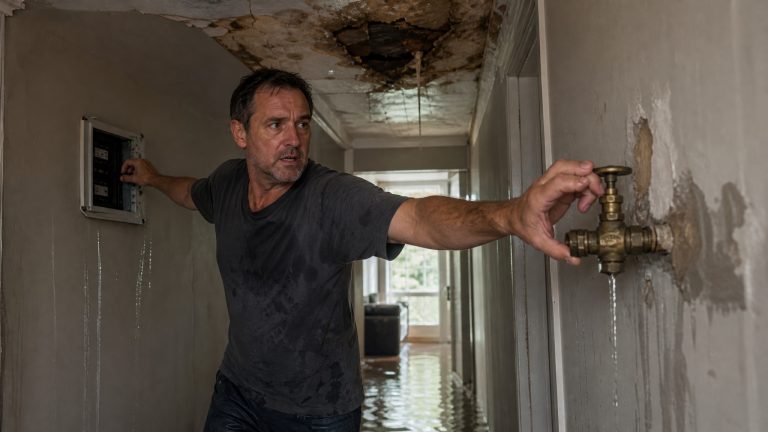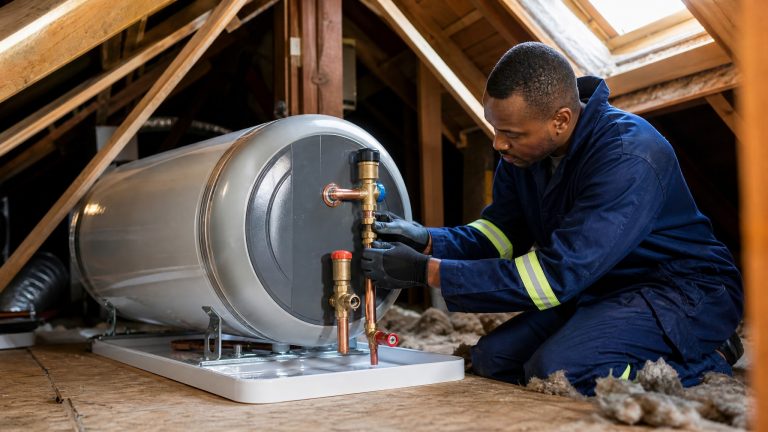
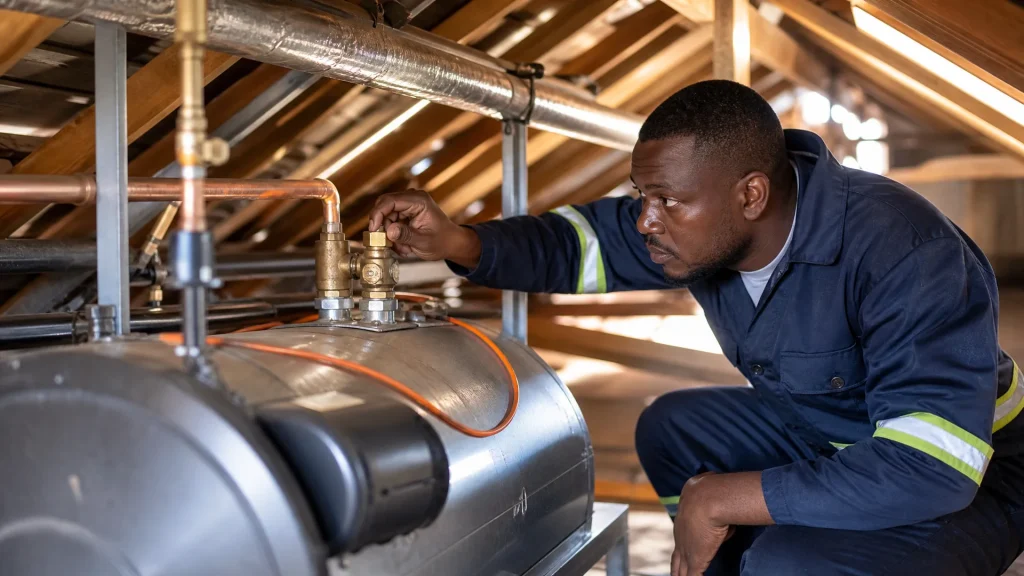
South Africa’s geyser installation requirements are more detailed than most homeowners realise. The gap between a compliant installation and a quick, cheap one is exactly where burst geysers, rejected insurance claims, and voided warranties live. If your geyser was installed without the right valves, venting, and support, you may already have a liability sitting in your roof. This guide walks through every geyser installation requirement in South Africa that matters: the regulations, the mandatory components, the correct pipe routing, and the shortcuts that routinely cause the most damage.
What South African Building Regulations Say About Geyser Installation
SANS 10254 and the National Building Regulations
SANS 10254 is the South African National Standard that specifically governs the installation and maintenance of hot-water systems. It covers all valve, venting, and support requirements for electric and solar geysers. You must read it alongside the National Building Regulations (NBR), which set the broader framework for safe building work.
Together, SANS 10254 and the NBR define exactly how a geyser must be positioned, supported, connected, and vented. They are not suggestions. A geyser installed outside these requirements is a non-compliant structure, and the homeowner carries the risk.
Who Is Legally Allowed to Install a Geyser?
Only a plumber registered with the Plumbing Industry Registration Board (PIRB) is legally authorised to install a geyser in South Africa. Any installation carried out by an unregistered person contravenes the National Building Regulations and exposes the homeowner to liability.
This applies to replacements, not just new installations. If a handyman swaps out your old unit for a new one, the installation is non-compliant from day one. DIY installation voids the manufacturer’s warranty and can trigger non-compliance findings from the municipality. When something goes wrong, and it often does, there is no cover to fall back on.
Geyser Safety Valve Requirements Every Homeowner Must Know
The most common reason home insurance claims are rejected after a geyser bursts is not the geyser itself. It is missing or incorrectly installed safety components. Registered plumbers regularly find missing pressure-reducing valves and unplumbed drip trays on geysers installed by unlicensed contractors, in many cases the units are only a few years old but already non-insurable.
Pressure-Reducing Valves and Temperature-Pressure Relief Valves
Two valves are mandatory on every compliant installation:
Pressure-reducing valve (PRV): This sits on the cold-water inlet and limits the pressure entering the geyser to the manufacturer’s specified maximum, typically 400 kPa for most South African residential units. High or fluctuating municipal supply pressure is a leading cause of geyser failure, so a correctly set PRV is not optional. Understanding the water pressure problems that affect geyser performance helps explain why this component matters so much.
Temperature-pressure relief (TPR) valve: This valve opens automatically if temperature or pressure inside the tank exceeds safe limits. It must be piped to a safe discharge point, more on that in the venting section. Without a functioning TPR valve, an overheating geyser becomes a pressure vessel with serious consequences.
Drip Tray, Vacuum Breaker, and Venting Line Requirements
Three further components are required by SANS 10254:
Drip tray: Every geyser must sit in a drip tray sized to catch the full water volume of the unit in the event of a slow leak. The tray must have a drain pipe that routes water to a visible external discharge point, not into the ceiling void.
Vacuum breaker: This small device prevents back-siphoning when the system loses pressure. It is frequently omitted on informal installations, and its absence can cause the geyser to implode under negative pressure conditions.
Venting line: The discharge pipe from the TPR valve must be correctly routed, covered in full in the next section.
Each of these components costs a fraction of the geyser itself. Skipping them to reduce installation cost is the single most financially damaging decision a homeowner can make.
Geyser Venting Regulations and Correct Pipe Routing
Correct venting is one of the most misunderstood geyser installation requirements in South Africa, and one of the most frequently botched by unqualified installers.
The discharge pipe from the TPR valve must terminate at a visible, safe location outside the structure. It cannot discharge into a wall cavity, the ceiling space, or any enclosed area. When the TPR valve activates, whether from excess temperature or excess pressure, boiling water exits the pipe at high velocity. That water must go somewhere safe and visible, so the homeowner knows the valve has triggered and the system needs attention.
SANS 10254 specifies a minimum pipe diameter for the discharge line, and the pipe must run continuously downhill from the valve to the discharge point. Any dip or rise in the pipe creates a water trap that prevents proper drainage and can hold pressure against the valve seat, causing it to weep or fail prematurely.
A homeowner whose geyser bursts and floods the ceiling may find their insurer rejects the claim outright if the TPR discharge pipe was routed into the roof void instead of terminating at a visible external point. This non-compliance is flagged on most assessor inspections. The insurer’s position is straightforward: a compliant installation would have discharged safely; the water damage is a direct result of the shortcut.
Improper venting is also a leading cause of undetected leaks. A dripping TPR valve discharging inside the roof accumulates moisture over months, rotting timber and damaging ceilings long before the homeowner notices anything. By the time visible damage appears, the repair bill, including burst pipe repair costs and ceiling restoration, far exceeds the cost of a correct installation from the start.
Geyser Installation Cost in South Africa and What Drives the Price
In 2026, a compliant geyser installation costs meaningfully more than the price of the unit alone. For a standard 150-litre electric replacement, the total installed cost, covering the unit, labour, a new PRV, TPR valve, drip tray, drain pipe, vacuum breaker, and isolator, runs well above what an online unit price suggests. The compliance components alone add a significant portion on top of the hardware cost.
Several factors push the final price up or down:
- Geyser size and type, a 200-litre unit costs more than a 100-litre unit, and a heat pump or solar system costs substantially more than a standard electric cylinder
- Accessibility, a geyser in a low-ceiling roof space or one requiring scaffolding takes longer to install safely
- Condition of existing pipework, old, corroded supply pipes often need partial replacement during a geyser swap
- Municipal compliance certificate, some areas require a certificate of compliance, which adds a small fee but provides legal protection
Getting multiple quotes is reasonable, but be cautious of quotes that are significantly below the market rate. Low quotes almost always reflect missing components or an unregistered installer, which transfers all the risk to you.
Standard Electric Geyser vs Solar Geyser Plumbing Connections
Solar geyser installations require additional plumbing connections that a standard electric replacement does not. A standard electric geyser needs a cold-water inlet (with PRV), a hot-water outlet, a TPR discharge line, a drip tray drain, and an electrical isolator. That is the baseline.
A solar geyser installation adds: a separate cold-feed supply to the collector panel, a thermosiphon or pumped circulation loop between the panel and the storage cylinder, and in many retrofit systems, an electric element backup wired into the cylinder. Pumped systems also need a controller, sensors, and correct pump sizing. Each of these is governed by both SANS 10254 and the manufacturer’s installation manual.
The bathroom renovation plumbing checklist is a useful reference if you are combining a geyser upgrade with a broader renovation, many homeowners upgrade to solar at the same time as a bathroom refurbishment, and the planning overlaps significantly.
Warranty Compliance and Insurance: Why Shortcuts Cost More
Most geyser manufacturers in South Africa, including Kwikot, Bosch, and Franke, require proof of PIRB-registered installation and correct component fitment to honour the product warranty. If a geyser fails within its warranty period and the installer cannot produce PIRB registration, the manufacturer has legal grounds to refuse the claim.
Home insurers work the same way. A burst geyser is one of the most common domestic insurance claims in South Africa. Insurers know this, and their assessors are trained to identify non-compliant installations. A missing PRV, an unplumbed drip tray, or a TPR pipe running into the roof void is grounds for outright rejection.
This is where the geyser replacement vs repair question becomes a compliance issue, not just a financial one. An older geyser that has been repaired multiple times without a compliance inspection may have accumulated non-compliant components over the years. Replacing it entirely, with a full compliant installation, resets the warranty clock and makes the unit insurable again. Repairing a non-compliant unit simply extends the liability. If you are buying a home, a pre-purchase plumbing inspection checklist should always include a geyser compliance check before transfer.
Common Installation Shortcuts That Fail, and How to Avoid Them
These are the five non-compliant shortcuts plumbers find most often during compliance inspections:
1. Missing or undersized PRV. Without a correctly sized PRV, the geyser operates at full municipal supply pressure, which can exceed the tank’s rated maximum. The risk is a slow weld failure or a sudden rupture. This is also a direct insurance exclusion.
2. TPR valve discharge piped into the roof void. This routes scalding water into an enclosed timber structure when the valve activates. It causes hidden water damage and is flagged on every competent assessor’s report.
3. No drip tray drain. A drip tray without a functioning drain is barely better than no drip tray. Slow condensation and minor leaks fill the tray over time and eventually overflow into the ceiling. The drain must run to a visible, external discharge point.
4. Geyser inadequately supported in the roof. SANS 10254 specifies support requirements for the geyser frame, straps, and the ceiling joists that bear the load. A 150-litre geyser full of water weighs over 200 kg. Insufficient support means the unit can shift, pull fittings loose, or in a worst case fall through the ceiling.
5. Incorrect isolator placement. The electrical isolator must be within sight of the geyser and accessible without touching live components. Isolators hidden behind insulation, or placed on the wrong side of the DB board circuit, fail both the electrical and plumbing compliance checks.
Every one of these shortcuts is avoidable. Every one of them shows up in failed insurance claims and damaged ceilings. Knowing when to call an emergency plumber instead of attempting a DIY fix matters, but the better move is ensuring the original installation was done correctly.
If you are unsure whether your current geyser meets South African installation requirements, a compliance inspection by a registered plumber will tell you exactly where you stand, before an insurer’s assessor does. Find a PIRB-registered plumber near you through plumber-plumbers.co.za to book a geyser compliance inspection or get a free installation quote.