
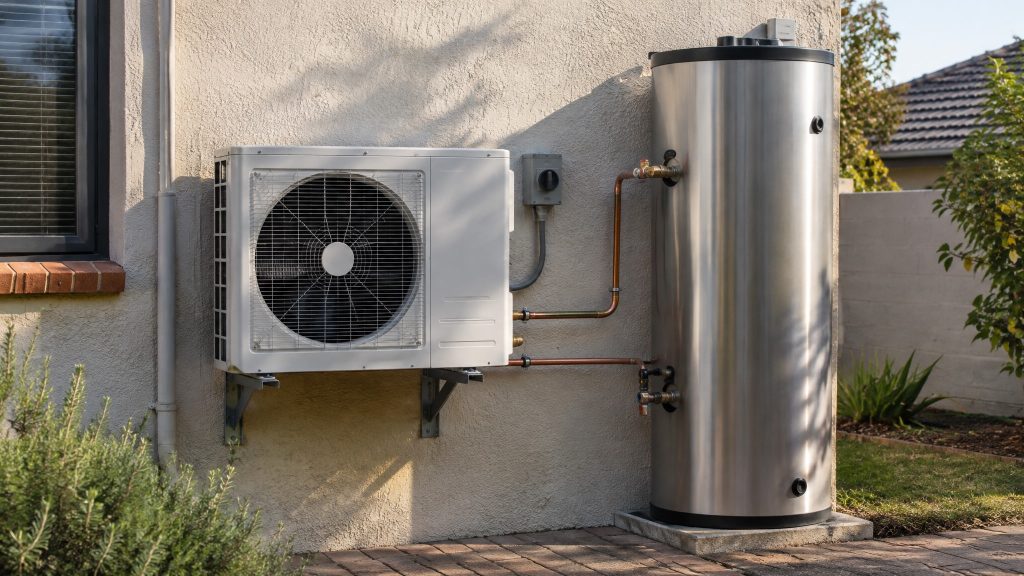
Load shedding changes what you should ask of a hot water system. A heat pump only heats while it has power, so the real question is how little it draws when power is on and how well your home rides out the gaps. This ranking of the best heat pump for load shedding in South Africa works through the ITS range with that in mind.
It covers eight units, from the 3.6 kW domestic model up to the 50 kW commercial one. It ranks them by rated output, because a smaller unit is easier to back up.
Why Energy-Efficient Hot Water Matters During Load Shedding
A heat pump uses a refrigeration cycle to move heat from the surrounding air into the water instead of making heat with a resistance element, which is why it draws less electricity per litre than an element geyser. That matters most when your backup is an inverter battery, because every unit of electricity you don’t burn on water is a unit left for lights, the router and the fridge.
Low energy hot water in South Africa comes down to two things: how much power the unit pulls when it runs, and how much hot water is already sitting in the tank when the lights go out.
The heat pump itself does nothing during a cut. It stops, and whatever hot water the tank holds is all you get until supply or a backup source returns.
If you plan around that, you can size your backup to the unit and stop guessing. This guide is not for anyone hoping a heat pump will produce hot water with no power at all, because it will not.
How We Ranked Heat Pumps for Load Shedding in South Africa
We ordered the models by rated output, from smallest to largest. Rated output is our proxy for peak draw, since a smaller unit is easier to run from an inverter or a generator and asks less of your battery bank.
Each placement then rests on what the product page says about controls, build and fit. Every unit in the set has a robust metal casing and Wi-Fi control except the ITS-50VD3pro, which is listed with GSM DTU connectivity instead.
Three limits apply, and you should keep them in mind when you read the ranking.
- Rated kW measures output, not efficiency. A higher number tells you the unit is larger, not that it wastes less energy.
- High-temperature models can use more electricity per litre, because making hotter water takes more work from the refrigeration cycle.
- A smaller unit refills the tank more slowly after a cut, so a small household with heavy morning demand may wait longer for a full tank.
A higher kW rating, then, usually means a larger peak draw, and it only means “better” if your hot water demand is large enough to need it.
Domestic Heat Pump Comparison for Smaller Homes
For a smaller household, the domestic heat pump comparison is simple: the lower the rated output, the easier the backup. Two units sit here, and the first is our strongest pick for a backup-first home.
ITS-3.6HD 3.6kW Domestic Heat Pump with Wi-Fi
The ITS-3.6HD ranks first. It has the lowest rated output in the set, and it is designed to reduce reliance on a conventional electric geyser element and is suitable for geysers of up to approximately 200 litres.
That suits a small household with a geyser of that size and a modest backup supply. If your inverter is not large, this is the model that asks the least of it.
The trade-off is refill speed. After a long cut, the 3.6 kW unit takes longer to bring a full tank back up than a larger one would. You can see the ITS-3.6HD for smaller households on its product page, including the Wi-Fi control it carries.
ITS-4.5HDSuper 4.5kW High-Temperature Domestic Heat Pump with Wi-Fi
The ITS-4.5HDSuper takes second place, and it is the one to look at if your household needs high-temperature output. It is a high-temperature residential air-to-water unit with a robust metal casing, an internal bronze circulation pump and a digital controller with built-in Wi-Fi, with app support.
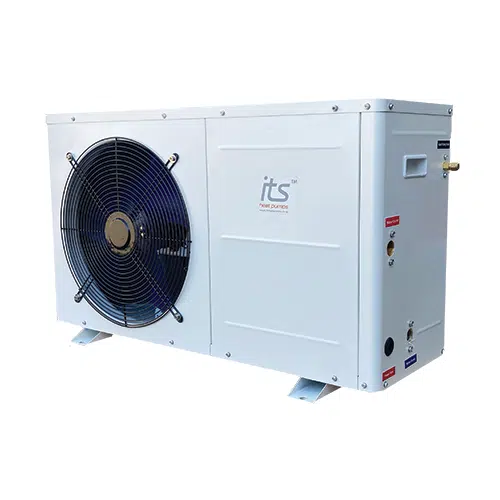
Hotter water comes at a cost. High-temperature designs usually trade some efficiency for that heat, so the ITS-4.5HDSuper will generally use more electricity per litre than a standard unit of similar size.
It also asks a little more of your backup than the ITS-3.6HD, because its rated output is higher.
Mid-Size and Larger Homes: ITS-5.4HD, ITS-6.3HDSuper and ITS-7.6HD
Once a household outgrows the smallest units, you are trading easier backup for more hot water and faster recovery. The three models below step up in that order.
ITS-5.4HD 5.4kW Domestic Heat Pump with Wi-Fi
The ITS-5.4HD ranks third, as the step-up from the ITS-3.6HD when you need more hot water. It is designed to reduce the electrical energy a conventional geyser element would need and carries current-generation Wi-Fi control, alongside an internal bronze circulation pump.
If your home has a mid-size geyser and a reasonably capable inverter or solar setup, the ITS-5.4HD with Wi-Fi control is the sensible next model to weigh against the ITS-3.6HD.
ITS-6.3HDSuper 6.3kW High-Temperature Domestic Heat Pump with Wi-Fi
The ITS-6.3HDSuper comes fourth and is the model for larger domestic hot-water needs. It is a high-temperature unit from the ITS Super series, with a metal casing, an internal bronze circulation pump, R134a refrigerant and a digital controller with Wi-Fi.
Its higher rated output means more peak draw. Check your backup can carry that draw before you commit, because a battery sized for the ITS-3.6HD will not stretch to this unit.
ITS-7.6HD 7.6kW Domestic Heat Pump with Wi-Fi
The ITS-7.6HD closes the domestic range in fifth place. It is a high-capacity residential unit designed for larger domestic hot-water systems, with R410A refrigerant, an internal bronze circulation pump and current-generation built-in Wi-Fi control.
Choose it for the largest domestic systems, where refill speed matters more than a light draw. It is the least forgiving of the domestic units on a small backup supply.
Backup Hot Water Plan for Power Cuts
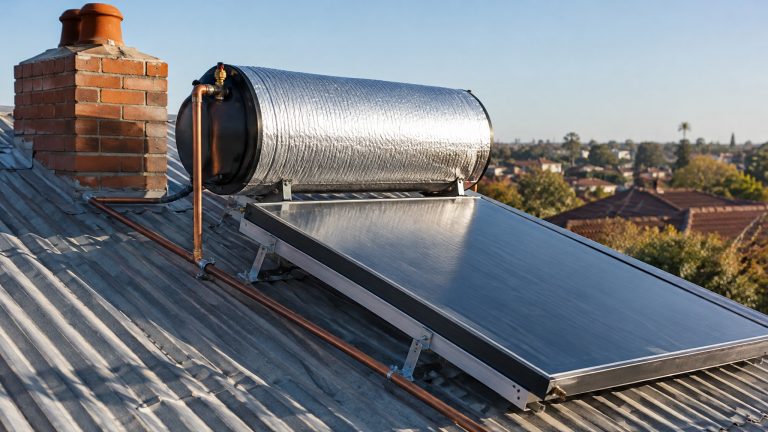
Your tank is the part of the system that actually survives a cut, so plan around it first and the heat pump second. For a household weighing solar as its backup, the heat pump versus solar geyser comparison sets out the two routes side by side.
Stored Hot Water as Your Buffer
An insulated tank keeps water hot for a good while, and that stored water covers your demand through a cut for as long as it stays hot. When supply returns, the heat pump refills the tank, so the hot water you lose during an outage is made back afterwards.
Backup sizing should follow the unit’s peak draw. A bigger heat pump needs a bigger inverter, battery or generator to run at all, while a smaller one fits a modest backup and simply takes longer to recover.
You can stretch the buffer by shifting heavy use, such as baths and washing, to the hours when power is on.
Heat Pump Running Cost During Power Cuts
Heat pump running cost during power cuts comes only from the backup source. With no power, the heat pump does not run and costs nothing; once an inverter battery, solar array or generator feeds it, that source carries the bill.
The factor that drives the cost is the unit’s draw multiplied by the hours it runs on backup. A smaller, standard-temperature unit draws less from your battery, while a larger or high-temperature unit empties it faster.
We have not put rand figures on this, because the cost depends on your battery, your generator fuel or your solar capacity. If you want a rough number for your home, send us your setup and we will help you work it out.
Commercial-Scale Options: ITS-11HD, ITS-22HD3 and ITS-50VD3pro
A commercial unit makes more sense than a domestic one when hot water demand is spread across many users or a large storage volume, such as a guesthouse, a clinic or a workshop with showers. A single home rarely needs one.
The ITS-11HD 11kW Single-Phase Heat Pump with Wi-Fi ranks sixth. It is the single-phase commercial option, so it suits sites that need more than the domestic range but do not have three-phase power.
Two units in this section need a three-phase supply, the ITS-22HD3 and the ITS-50VD3pro. Check the site before choosing either.
ITS-22HD3 22kW Three-Phase Commercial Heat Pump with Wi-Fi
The ITS-22HD3 ranks seventh. The ITS-22HD3 three-phase unit is a three-phase air-to-water unit with 22 kW rated heating capacity, horizontal air discharge and built-in Wi-Fi control for larger-volume water-heating systems.
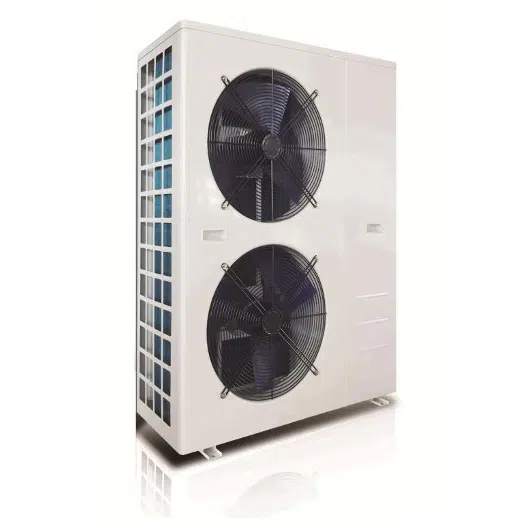
Its draw is far beyond what a typical home inverter can carry. For load shedding, that means a commercial site needs a generator or a properly sized backup system, not a household battery.
ITS-50VD3pro 50kW Three-Phase Commercial Heat Pump with GSM DTU
The ITS-50VD3pro ranks eighth and is the largest unit in the set. It is listed with GSM DTU connectivity rather than Wi-Fi, which suits sites where Wi-Fi coverage at the plant is patchy.
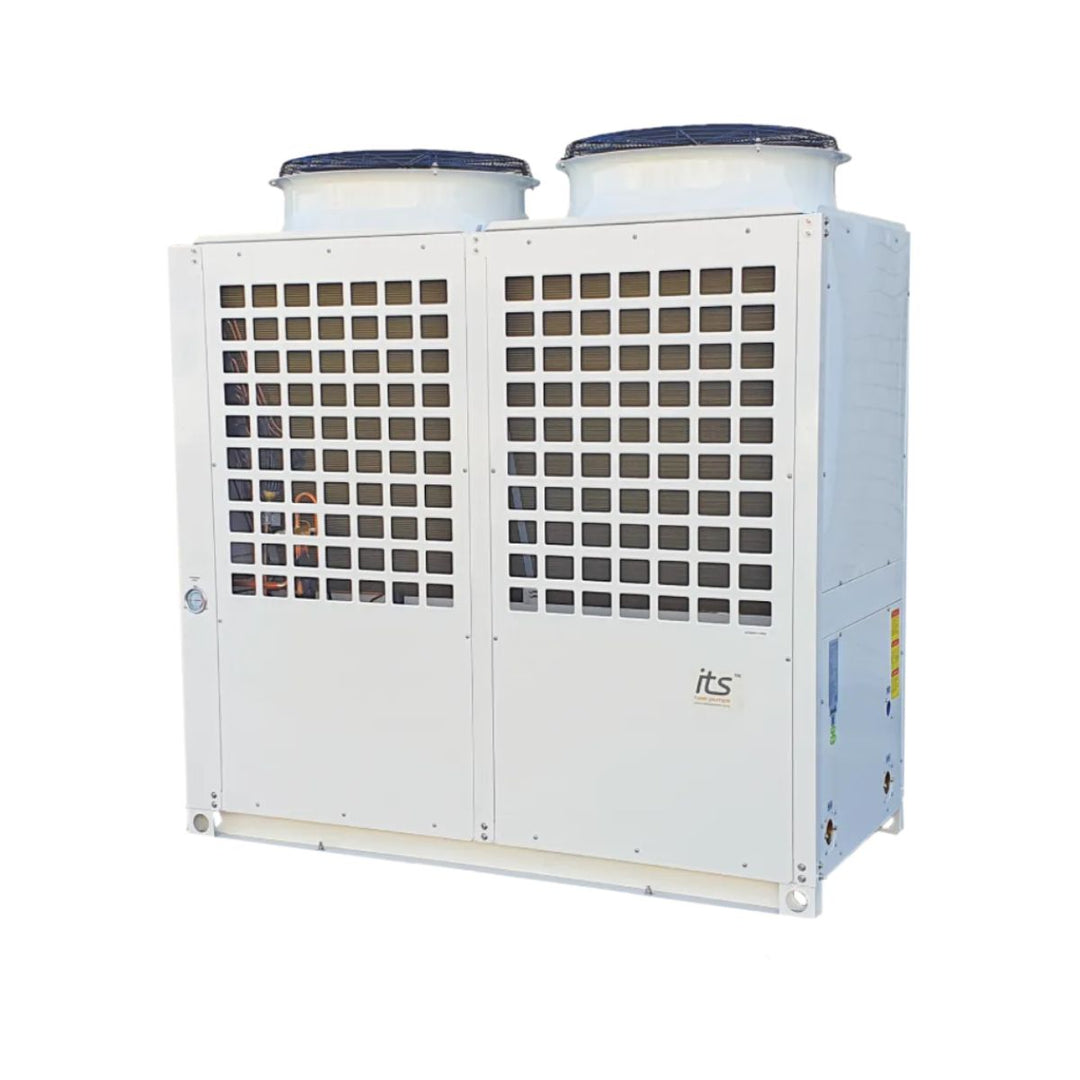
This unit is not for houses, and it is not a sensible choice for anyone whose main goal is a light draw during cuts. Sites weighing it should read up on commercial heat pump installation costs first.
ITS Wi-Fi Heat Pump Models: Monitoring Hot Water and Choosing a Unit
Seven of the eight models carry Wi-Fi control, and the ITS-50VD3pro is the exception with GSM DTU. When power returns after a cut, Wi-Fi owners can check the unit remotely rather than walking out to the cylinder.
To choose, work through three questions in this order:
- Household size. A small household with a geyser up to about 200 litres points to the ITS-3.6HD. Larger demand points to the ITS-5.4HD, ITS-6.3HDSuper or ITS-7.6HD.
- Supply phase. Single-phase homes and sites stay with the domestic range or the ITS-11HD. The ITS-22HD3 and ITS-50VD3pro need three-phase.
- Backup source. A modest inverter favours the smaller units. A generator or large solar array opens up the bigger ones.
If you are choosing for a backup-first home, start with the ITS-3.6HD. If your hot water demand is larger, the ITS-6.3HDSuper suits it, with the ITS-7.6HD for the largest domestic systems.
Installation cost varies by model and by site, because pipe runs, electrical work and the state of your existing geyser all change the job. For figures, see the current ITS heat pump prices by model and not a number guessed from a ranking article.
Many readers also compare these units against conventional geyser brand comparisons, which cover element geysers rather than heat pump draw.
Send us your geyser size, your household size and your backup setup, whether that is an inverter, solar or a generator. We will match you to a model and point you to its product page.
Frequently asked questions
What is the best heat pump in South Africa for load shedding?
For a backup-first home, the ITS-3.6HD is our strongest pick, because it has the lowest rated output in the range and is suitable for geysers up to about 200 litres. If your household needs more hot water, the ITS-6.3HDSuper suits larger demand, and the ITS-7.6HD suits the largest domestic systems. The right choice depends on your geyser size and how much backup power you have.
What is the most energy-efficient way to heat water in South Africa?
A heat pump draws less electricity per litre than an element geyser, because it moves heat from the air into the water rather than creating heat with a resistance element. That is why it suits homes trying to keep consumption down on an inverter. Solar is the other route, and the heat pump versus solar geyser comparison covers how the two differ.
How much does it cost to install a heat pump in South Africa?
Installation cost varies by model and by site, since pipe runs, electrical work and your existing geyser all change the job. We don’t quote a figure here. Current ITS heat pump prices by model are in the ITS price guide, and sending us your setup lets us tell you what to expect.
Which ITS heat pump is the most efficient?
You can’t tell from the kW rating, because rated kW measures output rather than efficiency. A larger unit has a higher peak draw, and a high-temperature model can use more electricity per litre than a standard one. Send us your geyser size and backup setup and we will recommend the unit that fits your needs rather than the biggest number.
1 Comment